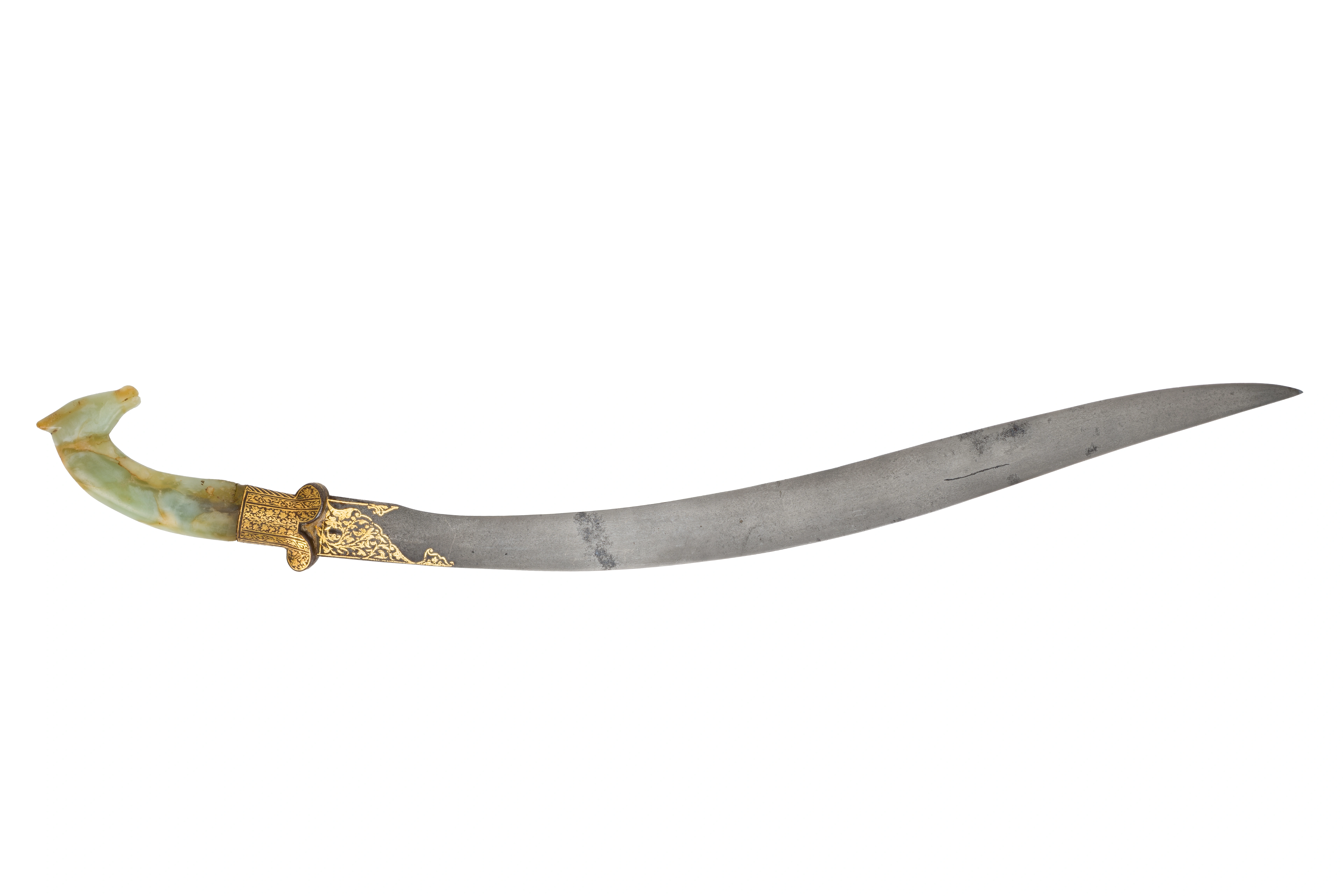
Sword
Late 17th century.т India. Steel. Hilt: Nephrite; gilding. 61.4 × 4.3 × 1.9 cm
Audio guide
Audio available in: RU
Description
This ceremonial blade dates to the Baburid Period, when weapons functioned not only as instruments of war but also as refined works of art and markers of elite status.
The curved steel blade reflects the advanced metallurgical traditions of South Asia, possibly related to crucible steel technologies renowned for their durability and sharp cutting edge. Its elegant curvature follows the functional evolution of Eastern sabres designed for effective slashing strikes.
The hilt, carved from jade, represents a material highly valued in both Timurid and Baburid court culture. Jade symbolized authority, protection, and moral strength. The sculptural pommel, shaped as an animal head, follows a long tradition of courtly symbolism associated with power and prestige.
At the base of the blade, vegetal ornament executed in gold inlay demonstrates the koftgari technique, a hallmark of Baburid decorative metalwork. Such scrolling floral motifs often alluded to the imagery of the paradisiacal garden central to Islamic aesthetics.
Its inclusion in the Babur section highlights the artistic continuity between Central Asia and India, where Baburid cultural traditions were preserved and transformed within a new imperial context.