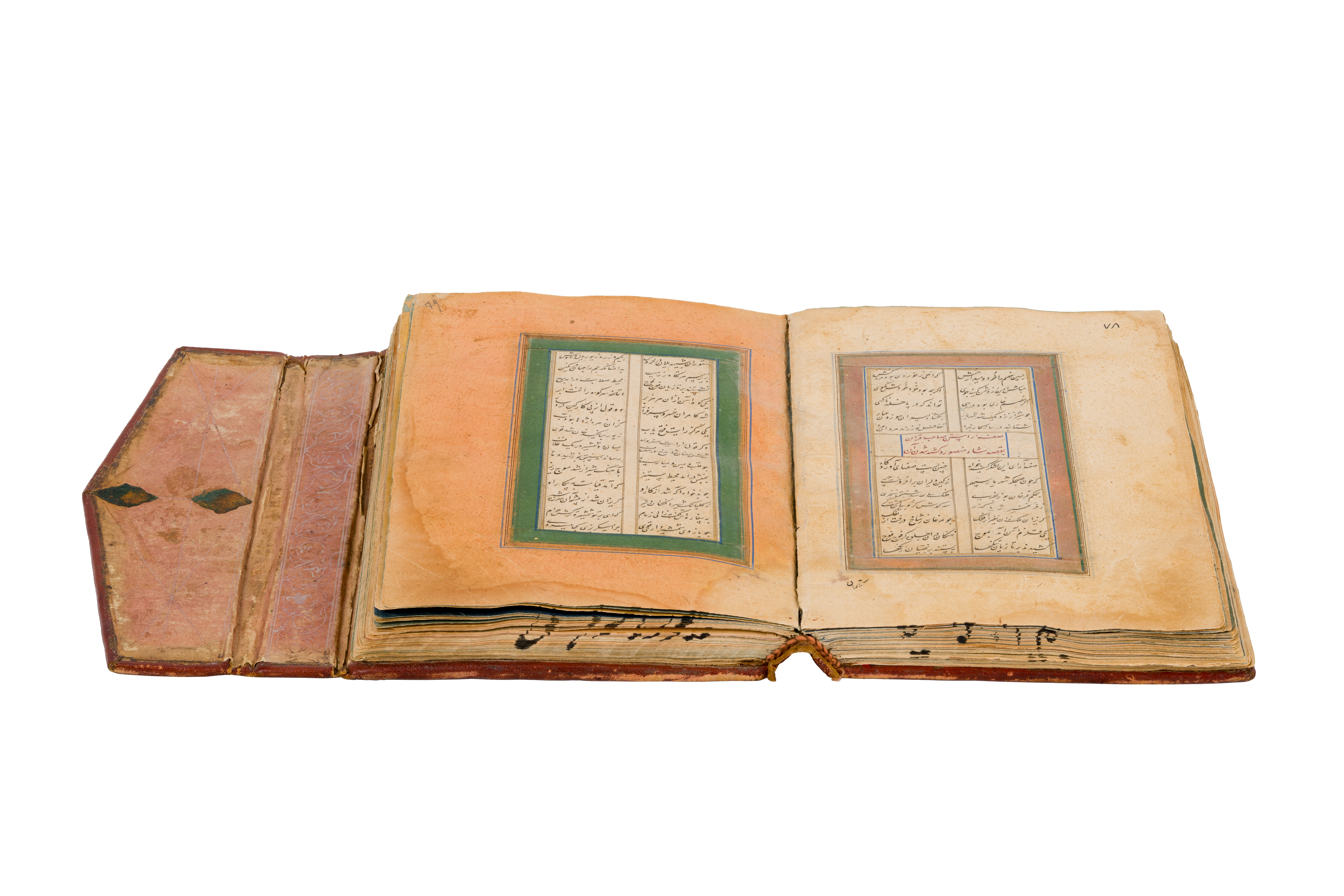
“Timurnama”
Abdullah Нatifi. Calligrapher: Ghiyath al-Din al-Jami. Copied circa 1536. Persian. Nastaliq script. Oriental paper. 14 × 22.5 cm. Manuscript of the Institute of Oriental Studies, Academy of Sciences of Uzbekistan
Description
This manuscript is not merely a historical narrative, but a poetic image of rulership created within the traditions of eastern epic literature. Abdullah Hatifi’s “Timurnama” is dedicated to Amir Timur and composed as a heroic masnavi, continuing the artistic legacy of Ferdowsi’s celebrated “Shahnama.”
This copy was transcribed around 1536, already during the Shaybanid period. Despite the dynastic transition, the memory of Timur and the Timurid era continued to hold an important place in the political culture of Mawarannahr.
The text is written in delicate nasta‘liq script arranged in complex two- and four-column compositions. Colored jadval borders and the gilded leather binding with a protective flap demonstrate the high level of courtly book art.
Such manuscripts were produced through the combined work of calligraphers, illuminators, and binders. They served not only for reading, but also as symbols of cultural prestige and historical continuity within Islamic Central Asia.