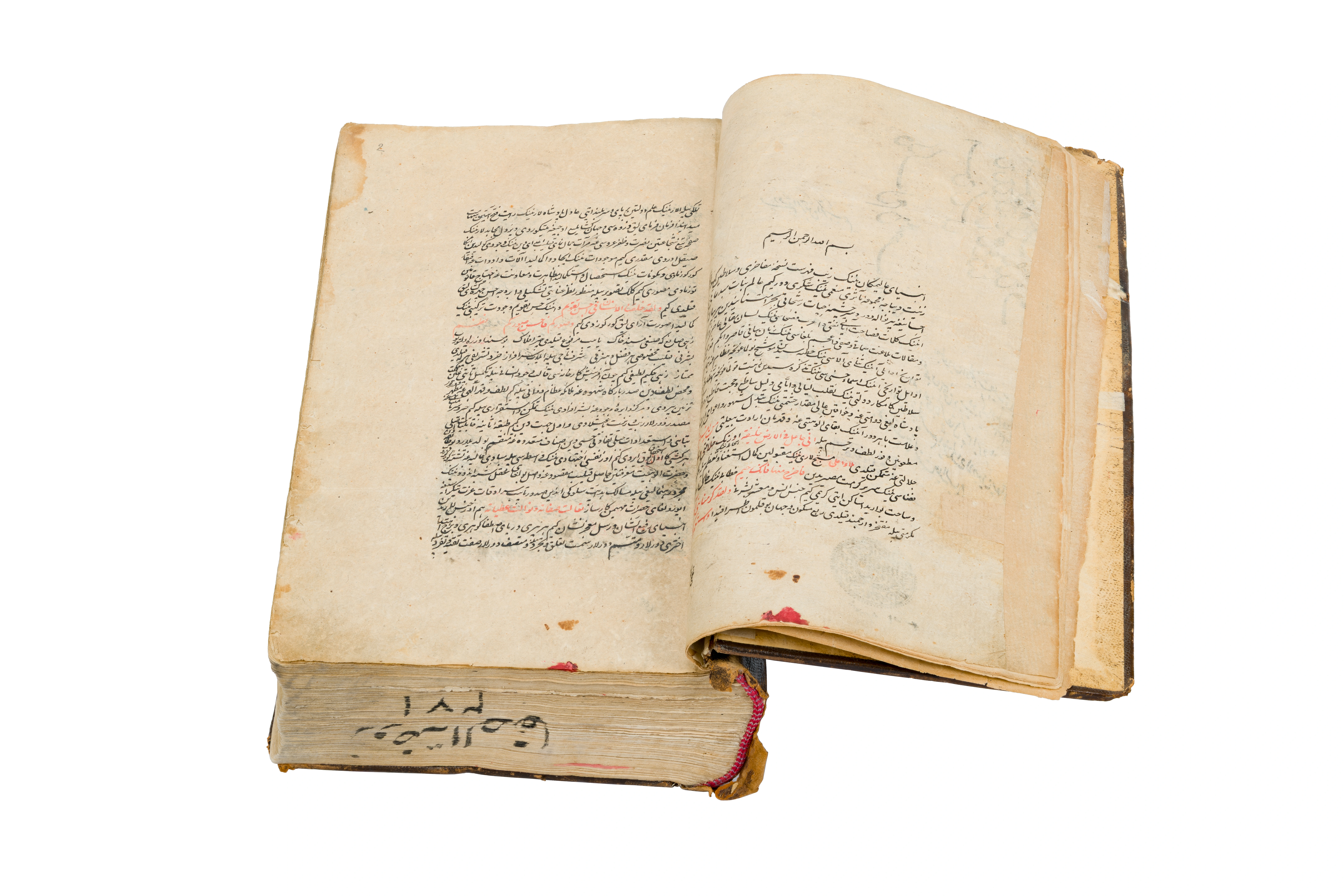
“Rawzat al-Safa”
Muhammad Khandshah Mirkhwand. Volumes I and II. Copied in 1820. Turkic translation, Nastalik script. Oriental and factory paper. 17 × 33.5cm. Manuscript of the Institute of Oriental Studies, Academy of Sciences of Uzbekistan
Description
The narrow vertical format of this manuscript recalls court chronicles and the working books of palace chanceries. Before us is a Turkic translation of “Rawzat al-Safa,” the celebrated universal history by Mirkhwand, copied in 1820 during the period of the late Central Asian khanates.
The original work was composed in fifteenth-century Herat in Persian, yet several centuries later the rulers of Khiva and Kokand deliberately sponsored translations of such chronicles into Turkic. This process reflected broader cultural and administrative changes, as the old Uzbek language increasingly became a medium of court history and governance.
The manuscript is especially significant for its material composition. It combines traditional handmade eastern paper with imported factory-made paper that entered Central Asia through trade connections with the Russian Empire. This hybrid structure preserves evidence of a transitional moment in the book culture of Mawarannahr.
The translation, begun by the poet Munis Khorezmi and completed by Agahi, made a complex historical narrative accessible to a much wider readership within the Islamic world of Central Asia.