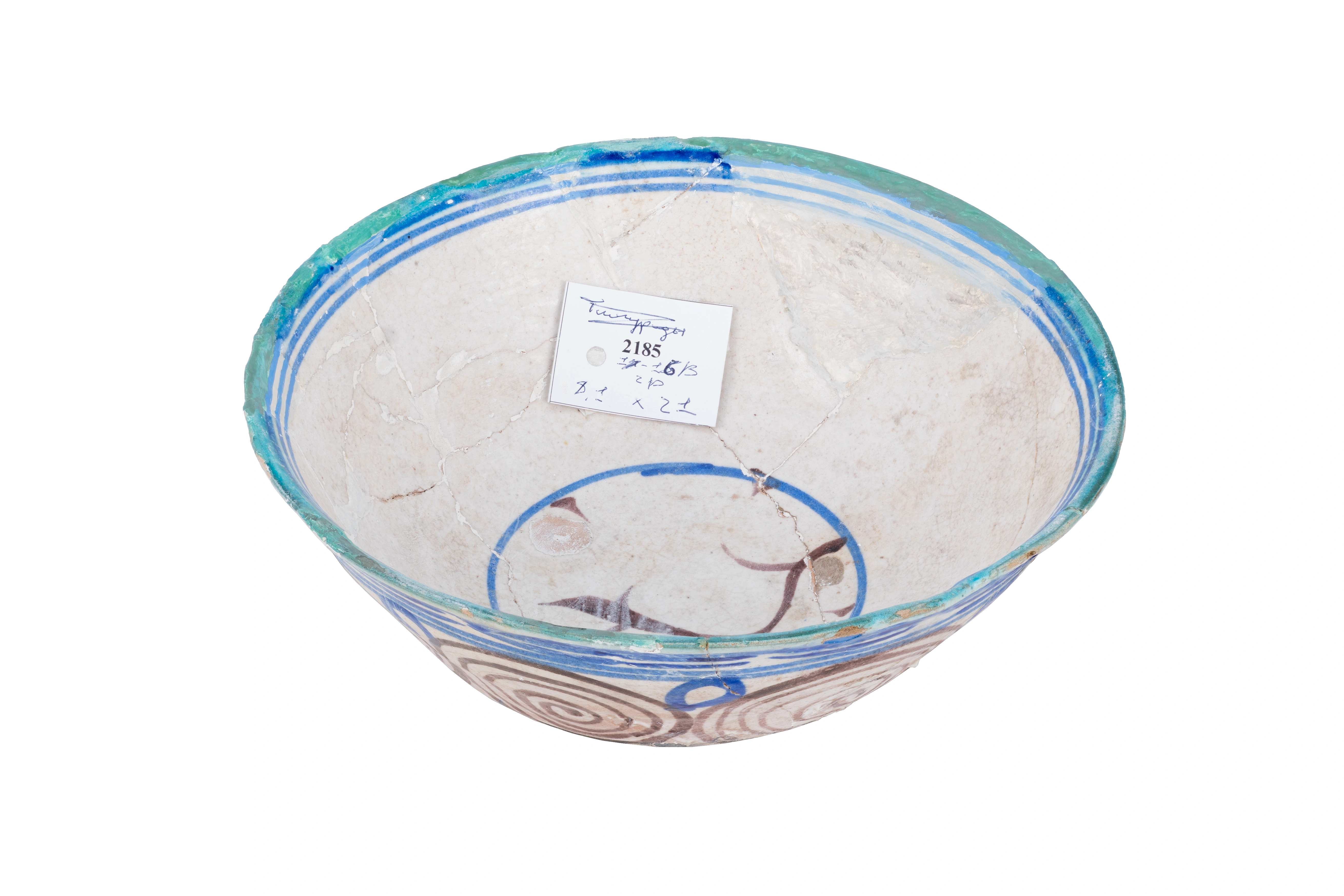
Bowl
15th century CE. Tashkent. Ceramic; engobe. 8.5 × 20.8 cm. WOSCU collection
Description
Ceramic bowls of the fifteenth century reveal how the artistic principles of the Timurid era entered the everyday life of Central Asian cities. This bowl from Tashkent combines a practical form with the expressive decorative language characteristic of the region’s craft centers.
The vessel is coated with a light engobe, a refined clay slip that created an even surface for painted decoration. Large spiral motifs in blue and dark pigment appear along the exterior. Such ornaments were common in the ceramics of fifteenth-century Tashkent and Samarkand and reflected aesthetic ideas of movement, rhythm, and the continuity of pattern.
The bowl preserves visible traces of time: cracks, restorations, and losses of individual fragments. These details are important not only as signs of age, but also as evidence of the object’s archaeological history. Similar ceramics are often discovered in the cultural layers of the old city, helping scholars reconstruct the craft traditions, trade networks, and daily life of medieval Tashkent.
Even utilitarian objects such as this bowl reflect the broader artistic environment of the Timurid Renaissance, in which ornament, colour, and form became part of a unified cultural language.