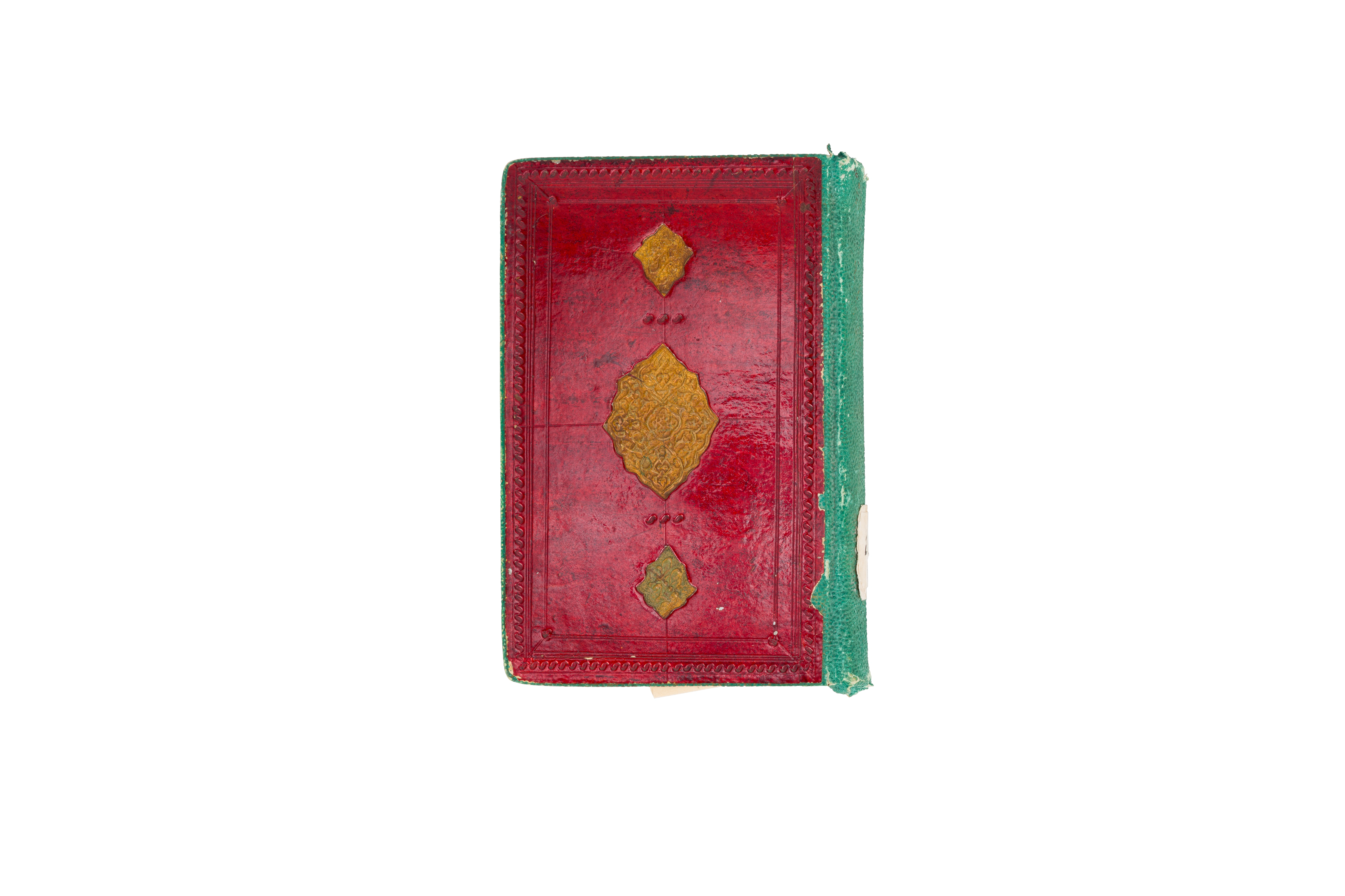
“Talkhisi Miftah”
Ghiyath al-Din Jamshid al-Kashi. Calligrapher: Saqi - Muhammad ibn Mulla Muhammad Amin. Copied in 1693. Central Asia. Arabic. Naskh script. Oriental paper. 12 × 18.5 cm. Manuscript of the Institute of Oriental Studies, Academyof Sciences of Uzbekistan
Description
This compact manuscript, “Talkhis Miftah,” is an abridged version of a major mathematical work by Ghiyath al-Din Jamshid al-Kashi, a leading scholar of the 15th-century Samarkand scientific school.
What we see here is not the original composition, but an adapted summary, a format widely used in the educational practices of the Islamic world. Such abridgements systematized complex computational methods and made them more accessible for study and practical use.
Pay attention to the page featuring a table outlined in red. Structures like this were used to organize numerical relationships and computational procedures. In some cases, numbers were represented using letters of the Arabic alphabet through the abjad system, which functioned as an auxiliary tool in mathematics and astronomy.
The manuscript is written in the naskh script, known for its clarity and compactness—qualities essential for scientific texts rich in numerical data.
Its relatively small and portable format suggests a practical function. Manuscripts of this type were likely used in madrasas or by professionals such as architects and engineers for calculating geometric forms, areas, and volumes.
The material is high-quality Eastern paper, whose smooth surface and durability ensured both precision in writing and long-term preservation.
The fact that this copy was produced in 1693 demonstrates the continuity of scientific tradition: more than two centuries after al-Kashi’s lifetime, his works continued to be copied, studied, and applied.
This manuscript thus reflects not only the level of mathematical knowledge, but also the mechanisms of its transmission in Central Asia during the early modern period.