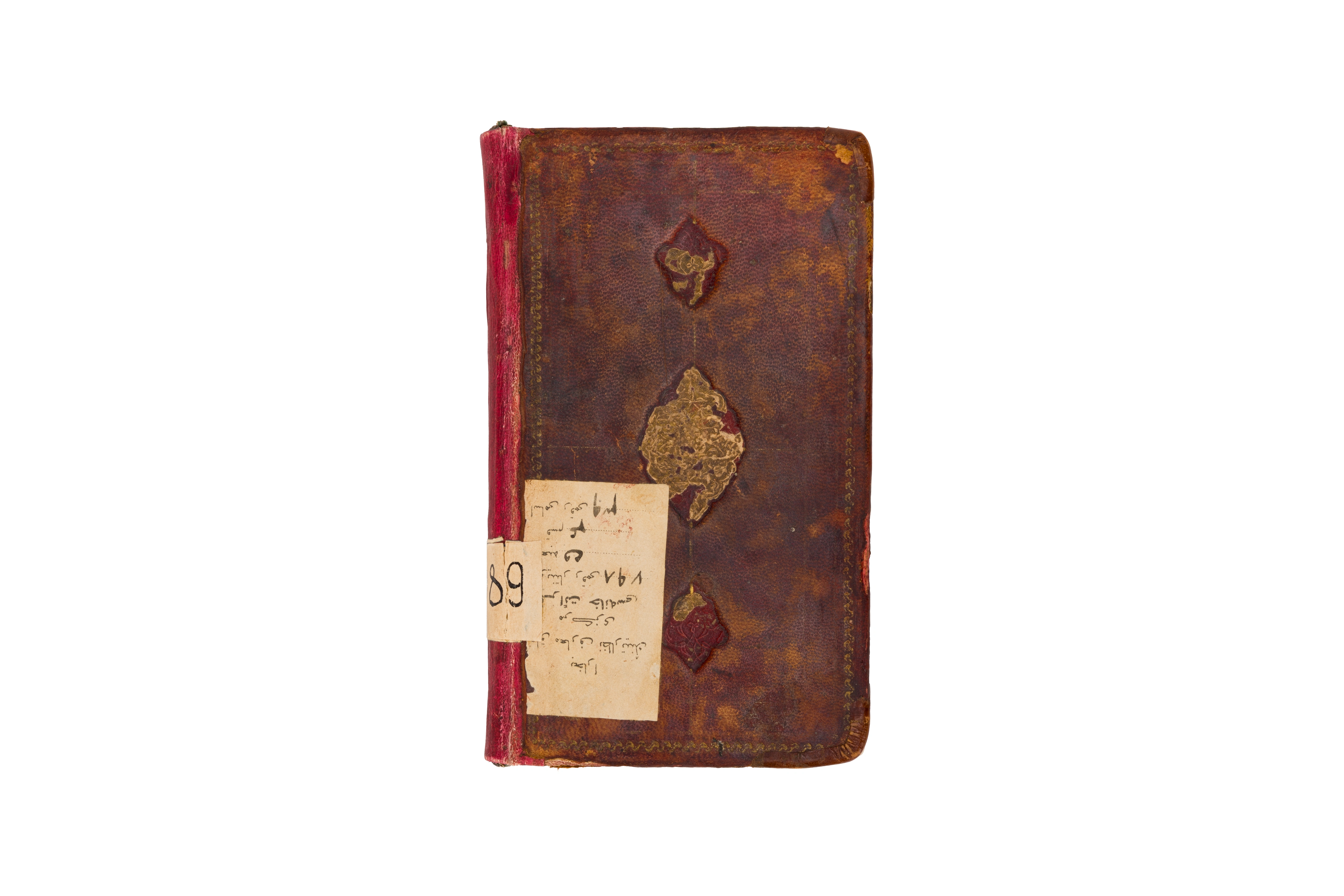
“Lata'if al-kiram fi ahkam al-a’vam”
Muhammad ibn al-Husayn–Sayyid Munajjim. Calligrapher: Muhammad Said. Copied in June–July 1645. Bukhara. Persian. Nastaliq script. Samarkand paper. 9.5 × 17 cm. Manuscript of the Institute of Oriental Studies, Academyof Sciences of Uzbekistan
Audio guide
Audio available in: UZ
Description
Before you is the manuscript “Lata’if al-kiram fi ahkam al-‘awwam,” copied in Bukhara in the summer of 1645 — a compact yet intellectually rich treatise reflecting practical knowledge of its time.
Notice the format: its small size indicates personal use. Such manuscripts were not intended for ceremonial display, but for everyday reference — portable, functional, and frequently consulted.
The text is written in nasta‘liq script. Despite its practical subject matter, the calligrapher Muhammad Sa‘id maintains a refined aesthetic discipline: balanced lines, clear structure, and careful proportions. This reflects a key principle of Islamic manuscript culture — even applied knowledge should be expressed in a harmonious visual form.
The title may be translated as “Subtle refinements of noble rules for common people.” The author’s nisba, “Munajjim,” suggests a connection to astronomy or astrology. Works of this type in the 17th century often combine astronomical observations, calendrical calculations, and practical recommendations for daily life. It is important, however, to understand such texts within their historical intellectual framework, rather than as scientific works in the modern sense.
The manuscript is written on Samarkand paper, renowned for its high quality. Its smooth surface allowed for precise writing and long-term preservation, as evidenced by the condition of the pages.
Created during the Ashtarkhanid period, this manuscript reflects Bukhara’s continued role as a center of learning and manuscript production. It stands as evidence of a durable tradition of knowledge transmission, where scholarly, practical, and cultural elements coexisted within a unified intellectual environment.