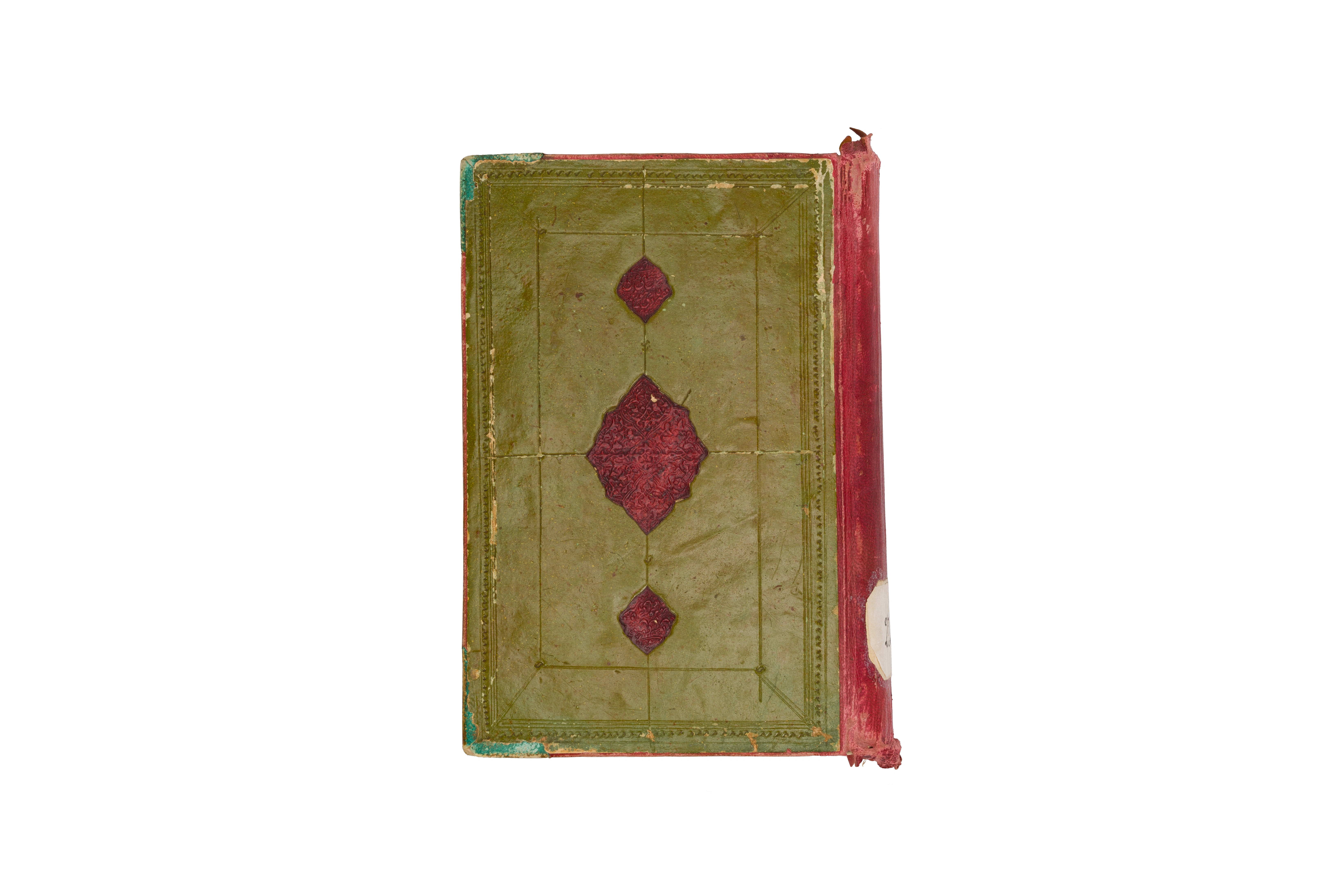
“Divani Kasimi”
Qosim Anvor. Calligrapher: Zaynuddin ibn Abdulloh Iroqiy. Copied in 1452. Persian. Nastaliq script. Oriental paper. 16 × 24.5 cm. Manuscript of the Institute of Oriental Studies, Academyof Sciences of Uzbekistan
Audio guide
Audio available in: UZ
Description
Before you is the manuscript of the “Divan of Qasim,” copied in 1452 — one of the earliest and most authoritative copies of the poetic legacy of Qasim Anvar, a prominent Sufi poet of the Timurid era.
Observe the binding: the leather cover with a central medallion and corner pieces reflects the classical book art of the 15th century. Despite visible wear, the composition remains clear — its restrained decoration and geometric structure emphasize the primacy of the written text.
Opening the manuscript, you encounter elegant nastaliq script. In the mid-15th century, this calligraphic style was still in the process of becoming the canonical script for Persian poetry. Its flowing lines and rhythmic inclination visually convey the musicality of the verses. The scribe, Zayn al-Din ibn ‘Abdullah, known as “Iraqi,” likely originated from western Iran, illustrating the extensive cultural networks of the Islamic world.
Qasim Anvar himself was a complex and sometimes controversial figure. His popularity in Khurasan aroused suspicion among the ruling elite. Following the events of 1427, he was forced to leave Herat. Yet in the following generation, his work gained recognition — Alisher Navoi regarded him as one of his spiritual guides.
The significance of this manuscript lies in its early date. Produced only a few decades after the poet’s death, it preserves a text close to the original and serves as a valuable source for scholarly study.
This manuscript exemplifies the layered cultural fabric of Islamic civilization: Persian poetic language, an Iranian calligrapher, and preservation in Central Asia. It stands as a testament to a unified intellectual space that once connected regions from Iran to Mawarannahr.