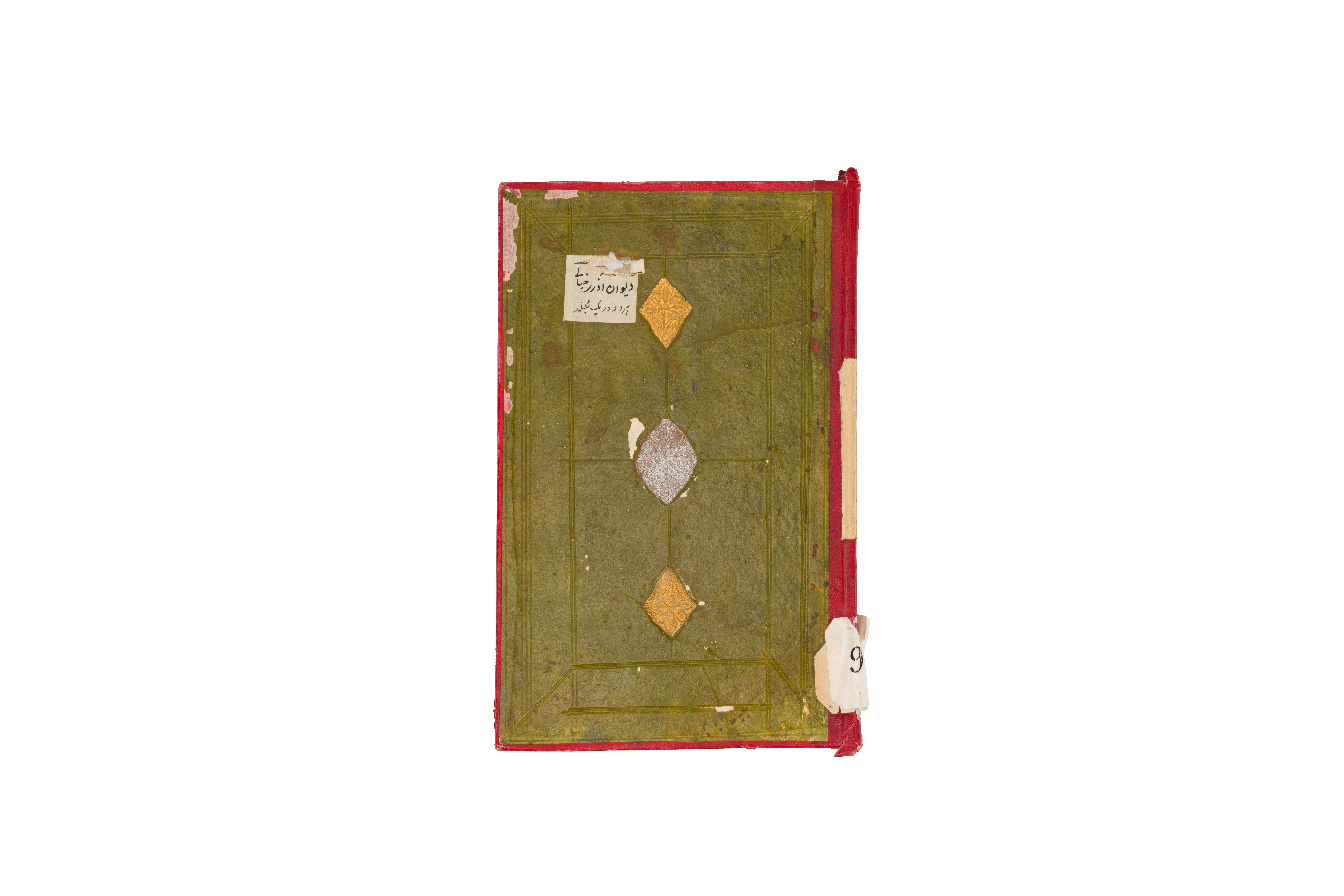
“Divan of Azari”
Hamza ibn Abdulmalik Tusi Baykhaqi – Sheikh Azari. Calligrapher: Muhammad Eshonkhoja Bukhari. Copied in 1850. Bukhara. Persian. Nastaliq script. Kokand paper. 13 × 21 cm. Manuscript of the Institute of Oriental Studies, Academyof Sciences of Uzbekistan
Audio guide
Audio available in: UZ
Description
This manuscript, the “Divan of Azari,” copied in Bukhara in 1850, reflects the of poetic and spiritual traditions rooted in the Timurid period.
The author, Sheikh Azari Tusi, was a 15th-century poet from Khorasan associated with the Sufi literary milieu. His works continued to circulate in Central Asia for centuries, demonstrating the lasting authority of Persian poetry in the region.
The manuscript is written on Kokand paper, a locally produced material widely used in the 19th century. Made from cotton fibers, this paper was valued for its durability and longevity, indicating a развитая regional craft economy.
The text is executed in nastaliq script, one of the most refined calligraphic styles in the Islamic world, especially associated with poetry. The hand of the calligrapher Muhammad Eshankhoja Bukhari shows controlled proportions and careful page layout.
The binding, with its central medallion and framed structure, follows earlier traditions of manuscript decoration. Despite visible wear, the compositional scheme remains legible.
This manuscript brings together multiple cultural layers: a Persian literary text, Central Asian material production, and the Bukhara calligraphic tradition. It demonstrates the continuity of classical Islamic literary culture in 19th-century Central Asia.