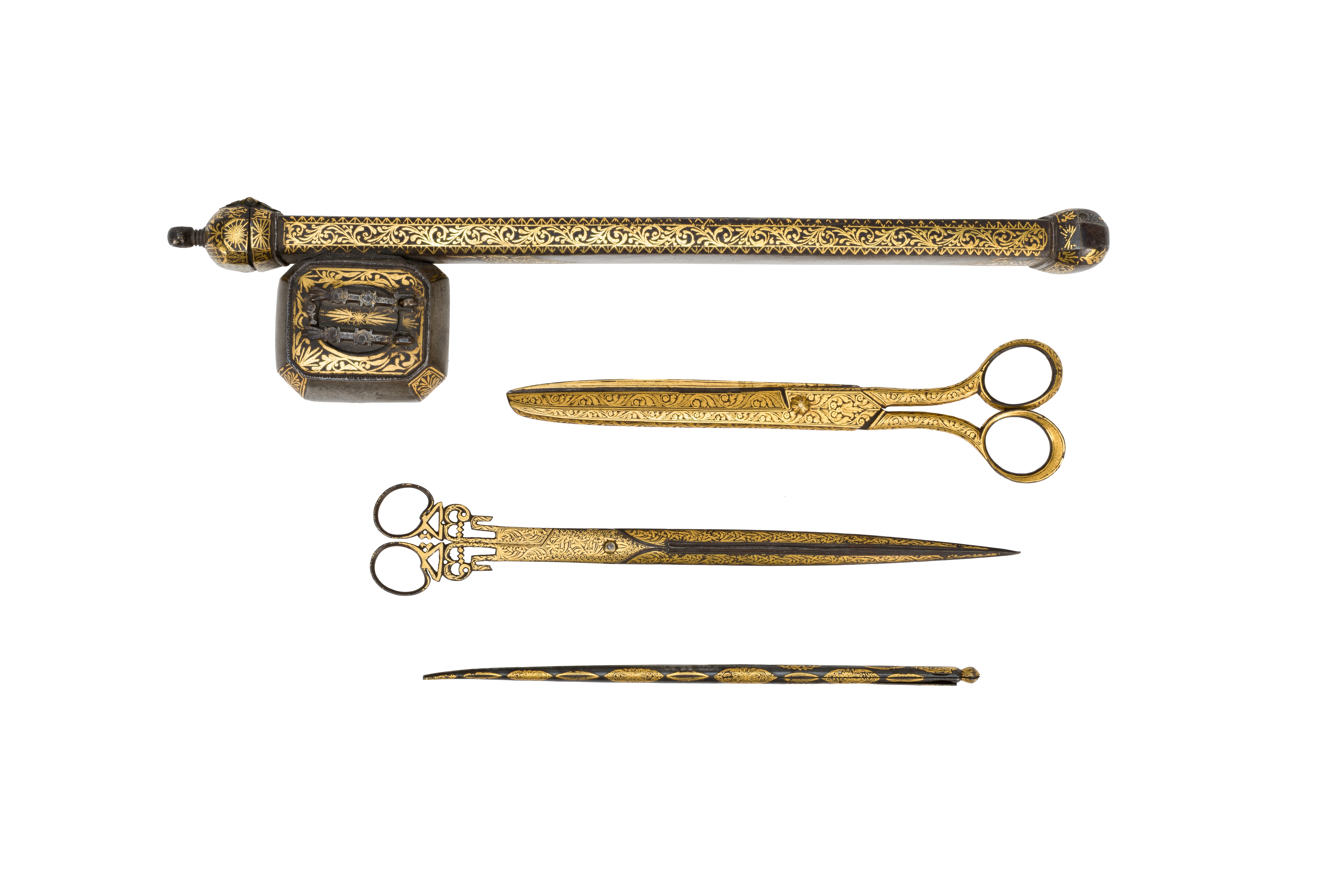
Collection of Book Art Tools
14th–16th centuries. Сentral Asia. Iron; gilded, inlay. Pencil box: 34.3 × 4.5 cm. Long scissors: 25.2× 4.3 cm. Scissors: 21.5 × 5.3 cm. Metal pencil: 21.7 × 0.7 cm
Audio guide
Audio available in: UZ
Description
Before you is a set of bookmaking tools dating from the fourteenth to sixteenth centuries, a period marked by the flourishing of manuscript culture in Central Asia. Such instruments were used in kitābkhānas—courtly workshops where calligraphy, miniature painting, and decorative arts were produced in a unified process.
The set includes scissors, a metal ruling instrument, and a case. Each element served a specific function in the preparation of manuscript pages. The long scissors were designed for precise cutting of paper, enabling smooth edges without damaging the fibers. Smaller scissors were used for shaping the qalam, the reed pen, and for other delicate operations.
The metal rod likely functioned as a ruling tool. In Islamic manuscript practice, text lines were not drawn in ink beforehand; instead, artisans created subtle blind impressions or incisions to guide the writing. This technique preserved the visual clarity and compositional discipline of the page.
The case provided protection and organization, ensuring the safe storage and transport of the tools. This was particularly important within the mobile and dynamic environment of Timurid court culture.
The decorative treatment of the objects is equally significant. The iron surfaces are embellished with gilding and inlay, forming intricate vegetal and geometric patterns. Such ornament reflects the aesthetic principles of Islamic art, where rhythm, symmetry, and abstraction convey a sense of universal harmony.
This set demonstrates the elevated status of bookmaking in Central Asia. Calligraphy was regarded not merely as a craft, but as an intellectual and spiritual discipline. Accordingly, even utilitarian tools were endowed with artistic value.
Thus, this ensemble represents not only a working kit, but a material expression of the manuscript tradition in which technique, knowledge, and aesthetics were inseparably intertwined.