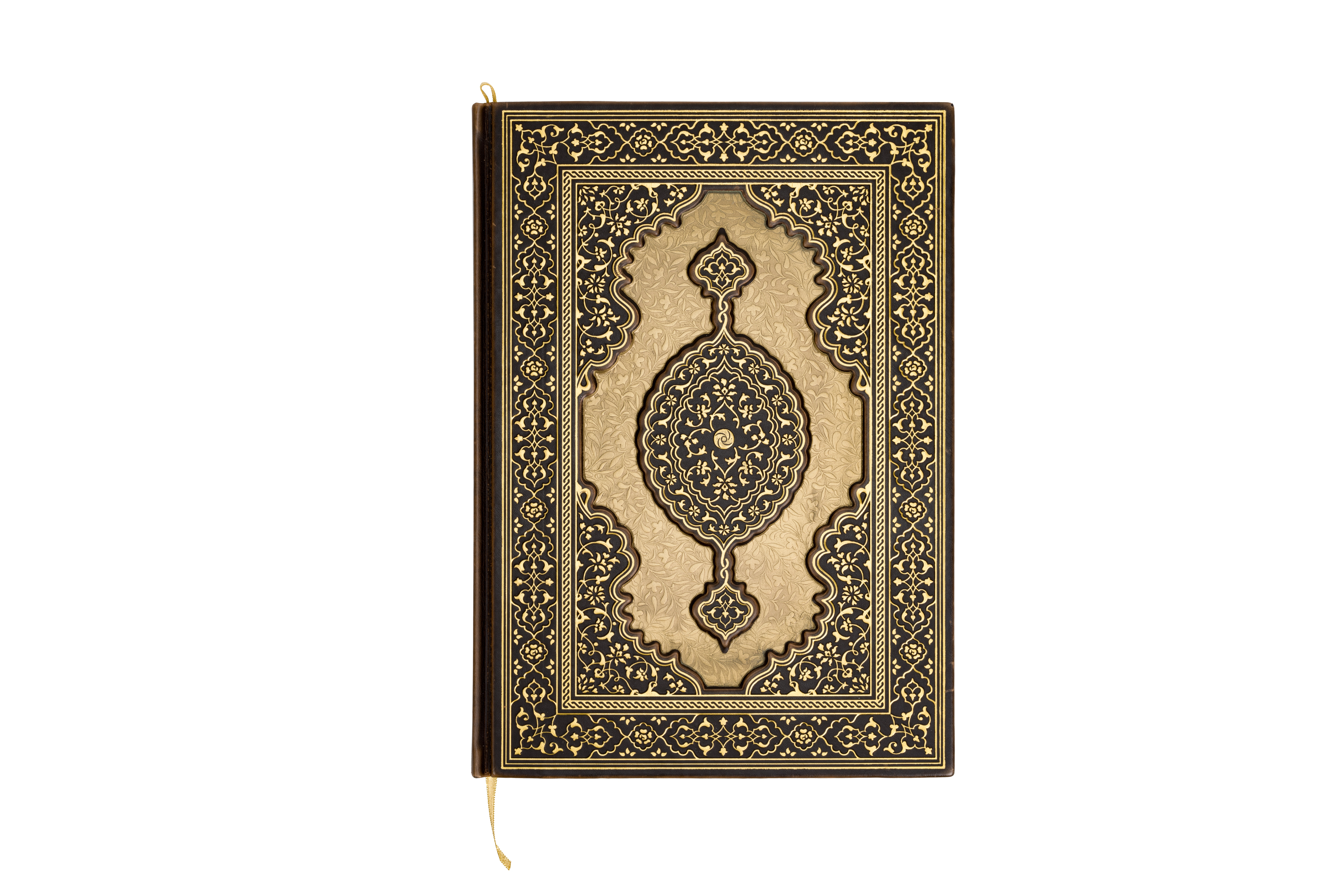
Miniature for the “Mi'rajnama”
15th century. Herat. Turkic. Uyghur script. Oriental paper. 40 × 30 cm
Audio guide
Audio available in: UZ
Description
Before you is a miniature from the manuscript Mi‘rajnāma, a narrative describing the Night Journey and Ascension of the Prophet Muhammad. This work was produced in the fifteenth century in Herat, one of the प्रमुख cultural centers of the Timurid period.
A defining feature of this manuscript is the combination of multiple cultural traditions. The text is written in a Turkic language, yet it is recorded not in Arabic script but in the Uighur script. This reflects a complex cultural environment in which Islamic literary traditions coexisted with earlier writing systems inherited from the administrative practices of the Mongol era.
Fifteenth-century Herat was a major intellectual hub where calligraphy, literature, and manuscript painting flourished. Manuscripts of this scale were collaborative works, involving calligraphers, painters, and decorative specialists. The large format suggests that this was a prestigious, possibly courtly commission.
The subject of the Mi‘rajnāma enabled artists to develop sophisticated visual imagery. In this cycle, the Prophet’s ascension is typically depicted in a symbolic manner, often accompanied by the mythical creature Burāq. Such representations are characterized by stylization rather than naturalism, in keeping with the conventions of Islamic manuscript painting.
The palette relies on mineral pigments such as lapis lazuli and cinnabar, as well as gold. These materials account for the remarkable durability and vibrancy of the colors over time.
This manuscript exemplifies the synthesis of cultural layers: a Turkic linguistic base, Persian artistic aesthetics, and an Islamic religious narrative. It demonstrates that Central Asian culture of the fifteenth century functioned as a dynamic and integrative system.
Thus, this miniature is not merely an illustration of a sacred text, but also an important document reflecting the interaction of artistic, linguistic, and political traditions in the Timurid era.