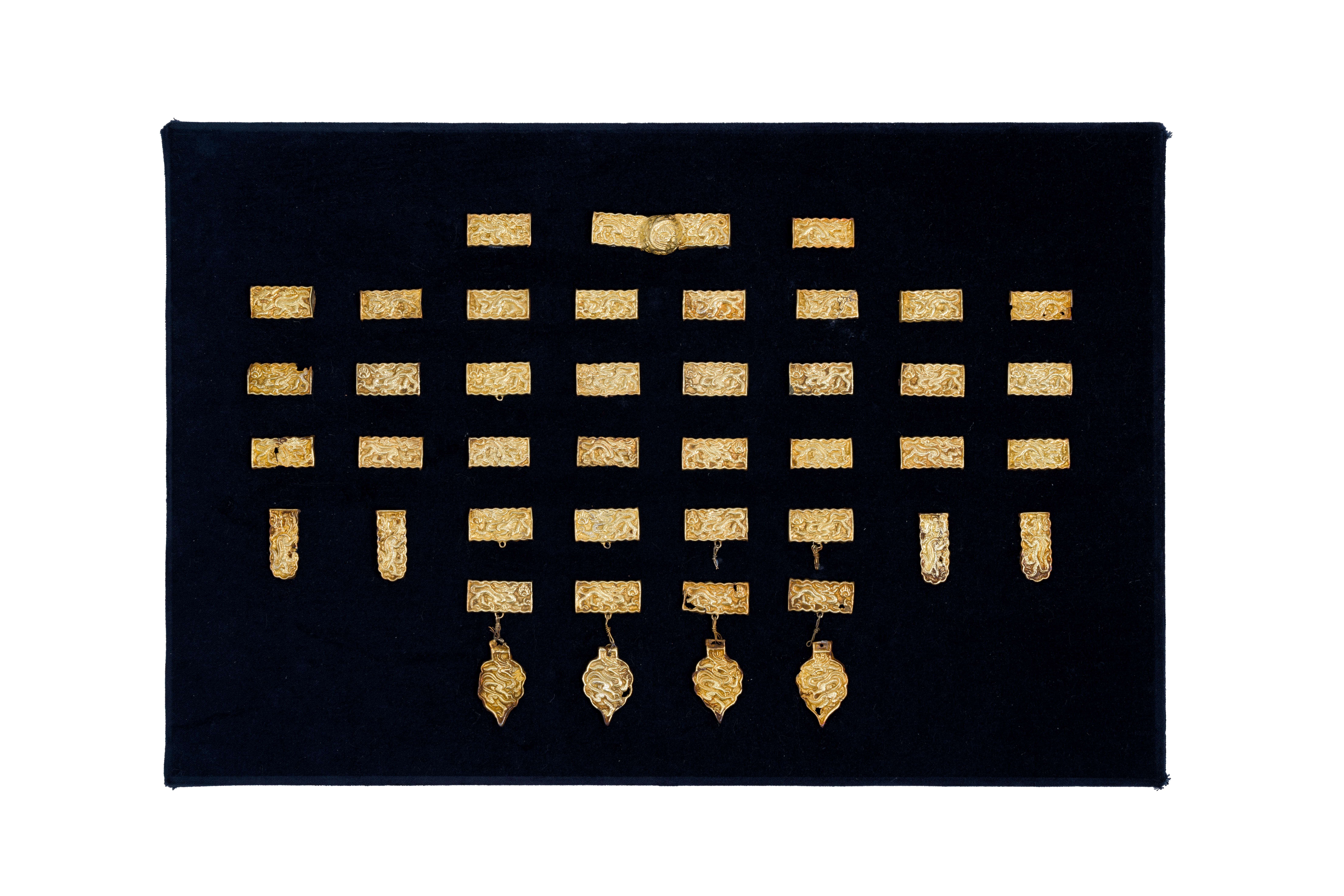
Horse Harness Decorative Parts (set of 39)
14th century. Сentral Asia. Gilded silver, stamp. Dimensions vary
Audio guide
Audio available in: UZ
Description
Before you is a set of decorative elements for horse harness dating to the fourteenth century—a period when the horse in Central Asia functioned not only as a means of transport, but also as a key indicator of social status.
The ensemble consists of numerous gilded silver plaques and pendants designed to adorn various parts of the harness, including the bridle, breast strap, and saddle fittings, forming a unified decorative system.
The material and technique are significant. The base is made of silver, valued for its durability and malleability, while the surface is gilded. The ornament is executed using stamping, which implies the use of pre-prepared matrices. This points to the existence of specialized workshops and a degree of standardization in decorative production.
The motifs belong to the vegetal arabesque tradition known as islīmi. Flowing tendrils and symmetrical compositions reflect the characteristic emphasis in Islamic art on rhythm and the continuity of form. Scholars also note possible indirect influences from East Asian artistic traditions, transmitted through intercultural exchanges of the thirteenth and fourteenth centuries.
Particular attention should be paid to the pendants in the lower row. When in motion, they could produce a subtle metallic sound. In the cultural context of Central Asia, such sounds were sometimes associated with protective functions, although their primary role remained decorative.
It is important to note that such complete sets were typically owned by members of the military and political elite. The adornment of the horse formed an integral part of visual representation, especially in a culture where rider and horse were perceived as a unified entity.
Thus, this ensemble reflects not only refined metalworking techniques, but also the synthesis of nomadic martial traditions with the artistic language of Islamic urban culture in the fourteenth century.