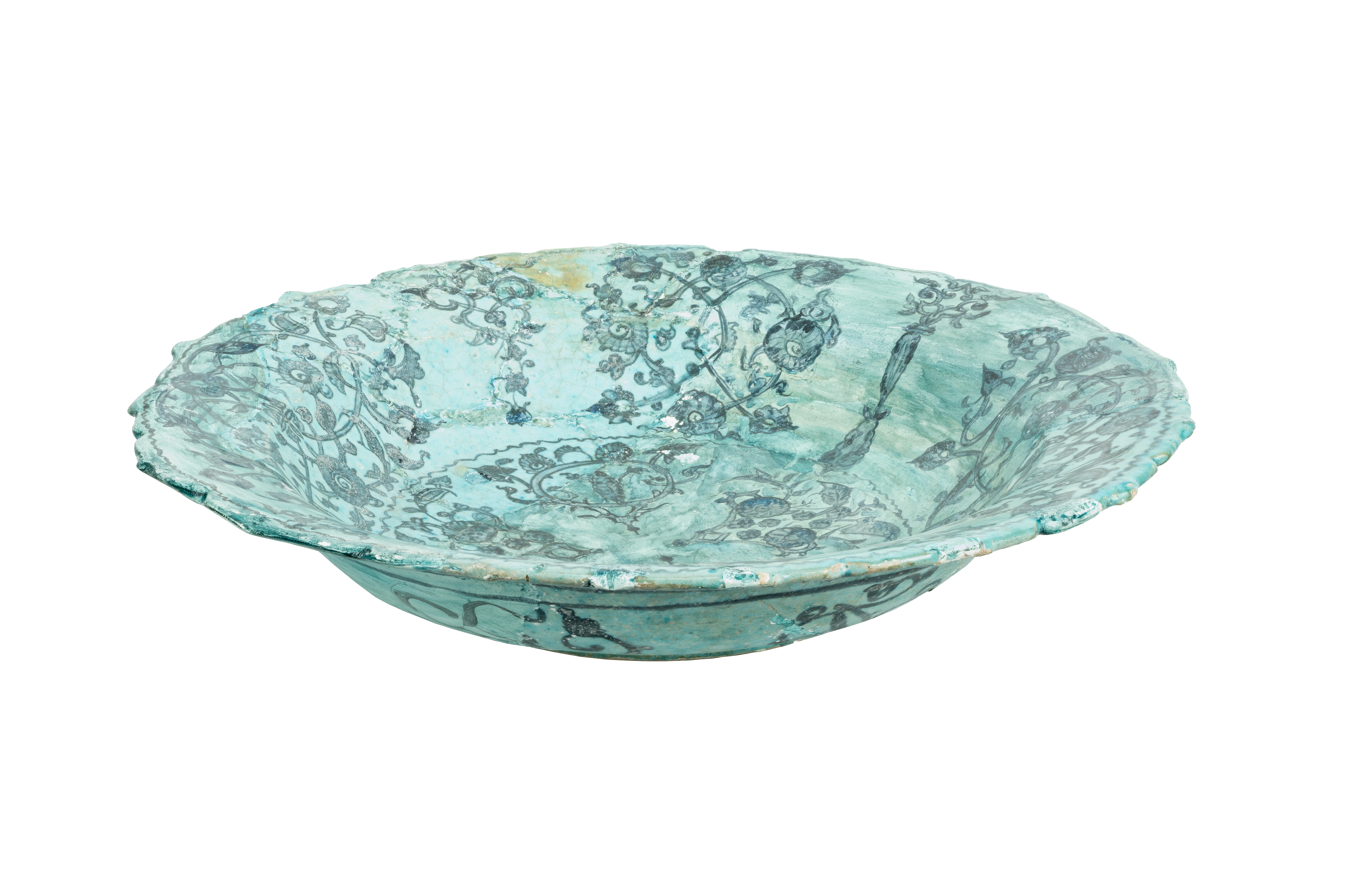
Serrated-Edge Dish
15th century. Tashkent. Ceramic; engobe, manganese painting, turquoise glaze. 7.3 × 38.5 cm. WOSCU collection
Audio guide
Audio available in: UZ
Description
This large ceramic dish from fifteenth-century Tashkent reflects the high level of craftsmanship achieved in the Timurid period, when Central Asian cities became important centers of artistic production connected to the wider networks of the Silk Road.
One of its most striking features is the turquoise glaze, a color strongly associated with the visual culture of Central Asia. Symbolically linked to the sky and water, turquoise was often understood as a color of protection and благословение, reflecting ideas of harmony and well-being.
The decoration consists of elegant vegetal motifs related to the islimi tradition. The flowing lines form a continuous ornamental field reminiscent of a garden. In Islamic visual culture, such imagery often alludes to the idea of paradise as a place of eternal abundance and balance.
The technology is equally significant. To achieve a light background, potters applied an engobe — a refined white clay slip — over the ceramic body. The design was then painted with manganese pigment and covered with a transparent colored glaze.
The scalloped rim is another notable feature. Its shape likely echoes precious metal vessels used in courtly settings, demonstrating how ceramic workshops translated elite artistic forms into more widely accessible materials.