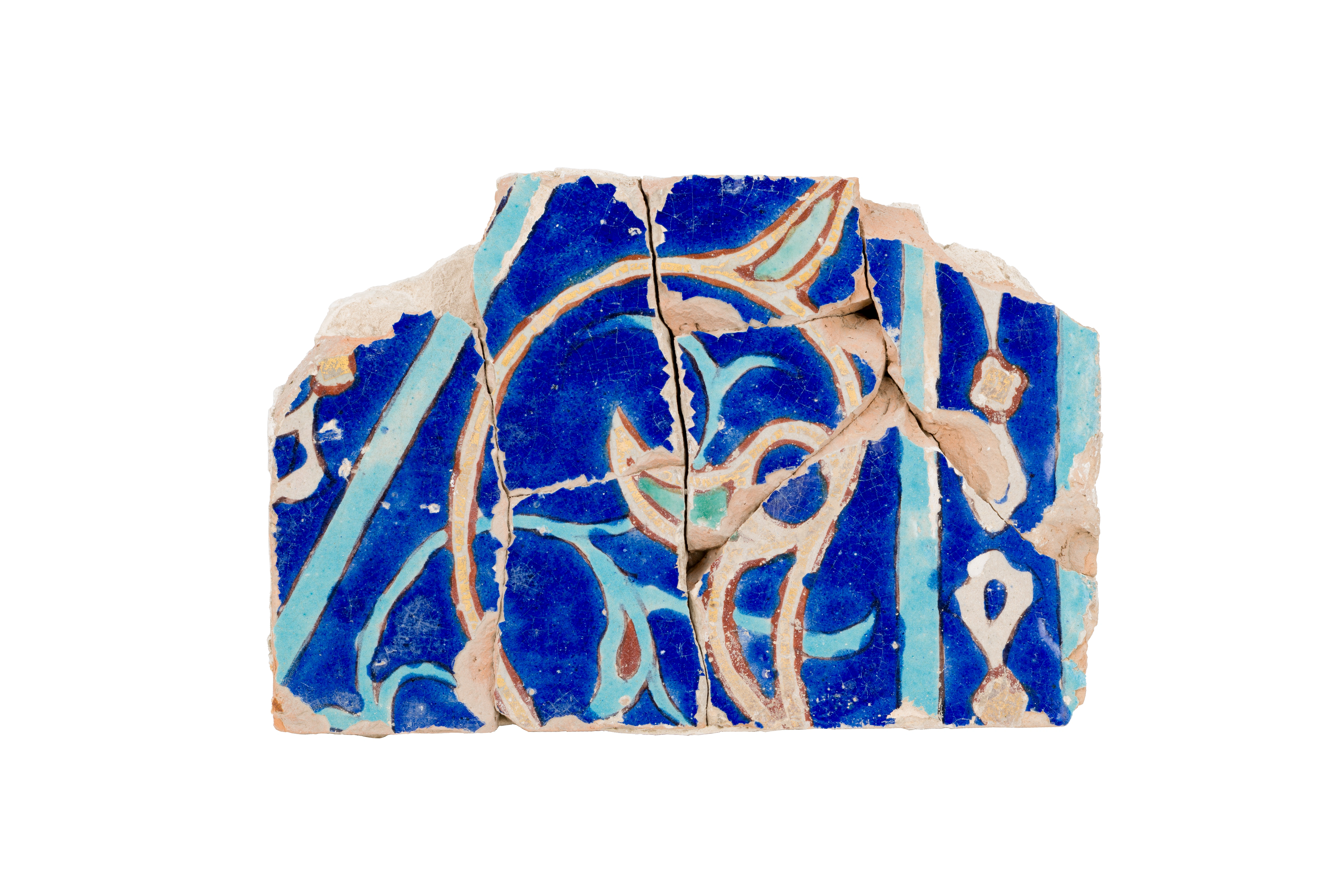
Architectural Decorations
14th–15th centuries. Samarkand. Shah-i-Zinda. Ceramic, colored pigments, glaze. 23.6 × 17.7 × 4.4 cm11.4 × 9.7 × 2.4 cm19.6 × 26.8 × 8.8 cm20.5 × 30.3 × 7.5 cmWOSCU collection
Audio guide
Audio available in: RU
Description
These fragments of architectural decoration comes from the famous Shahi Zinda ensemble in Samarkand, one of the most remarkable architectural complexes of the Timurid period. Even a small surviving element such as this reveals the sophistication of the decorative programs that once covered these monuments.
The first striking feature is the intense color palette. Deep cobalt blue and turquoise glazes became hallmarks of Timurid architecture. These colors were not merely decorative but symbolic, evoking the sky, eternity, and divine harmony, transforming architectural surfaces into reflections of a cosmic order.
The ornament belongs to the islimi tradition — an intricate vegetal scroll pattern formed by continuously flowing stems and leaves. Such motifs deliberately avoid clear beginnings or endings, visually expressing the Islamic concept of infinity and the unity of creation.
Equally important is the technique. Many such decorations were produced using the mosaic faience method, in which individually cut pieces of glazed ceramic were assembled into complex compositions with remarkable precision. This process required both mathematical planning and exceptional craftsmanship.
Fragments like this testify to the role of fourteenth- and fifteenth-century Samarkand as a major center of artistic innovation, where architecture, geometry, and decorative arts were integrated into a unified Timurid aesthetic.