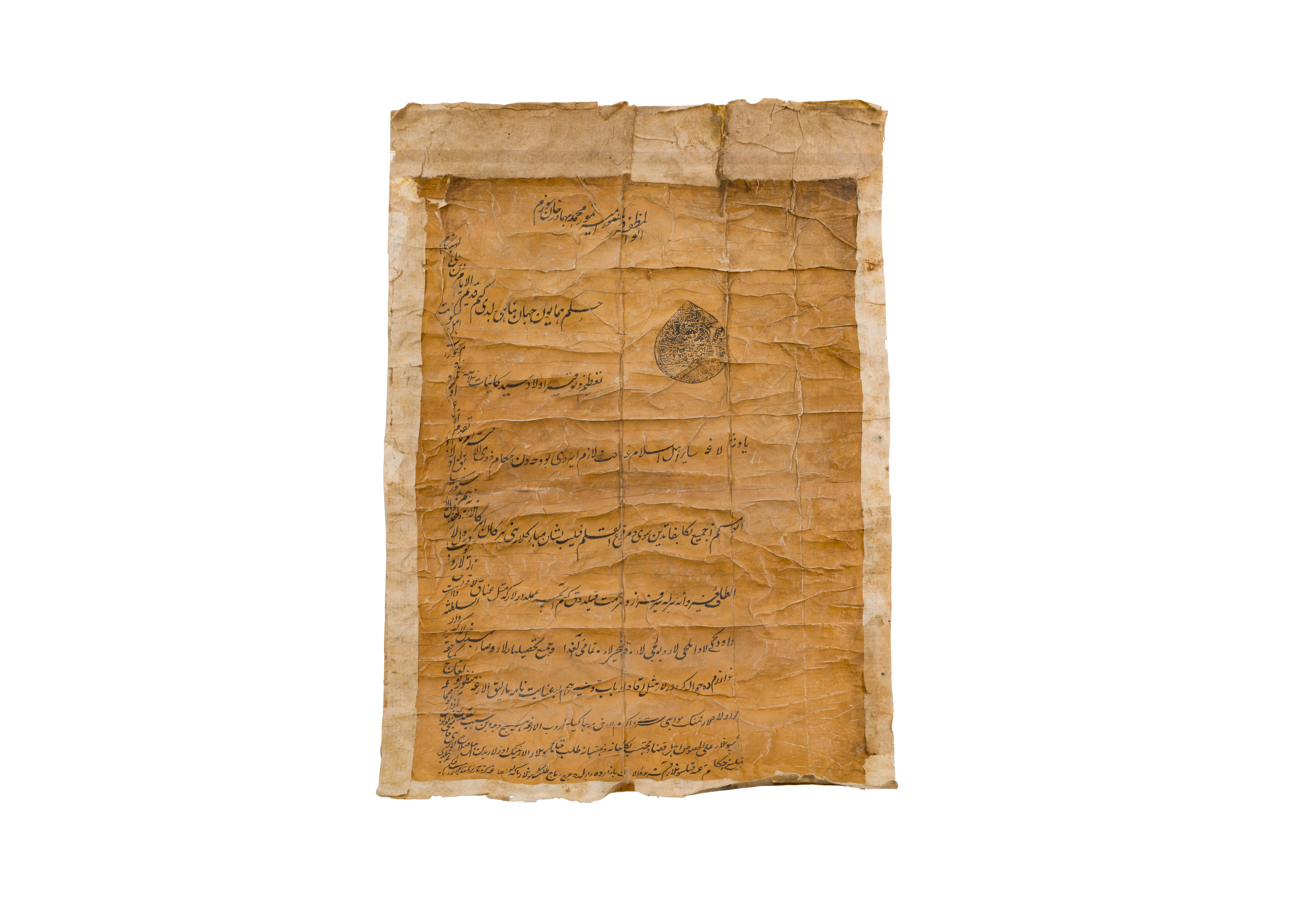
“Turkic Decree of Amir Timur”
A document on the privileges granted to the descendants of Abu Muslim. 14th century. Central Asia. Nastaliq script. Paper. 44.5 × 30 cm. Manuscript of the Institute of Oriental Studies,Academy of Sciences of Uzbekistan
Audio guide
Audio available in: UZ
Description
Before you is a rare document from the era of Amir Timur – a Turkic yarlik, an official decree granting specific privileges and legal rights.
Such documents belonged to the category of tarhan charters. They conferred exceptional status upon their holders, including tax exemption, judicial immunity, and direct protection from the state. In the context of medieval society, possession of such a document effectively placed its bearer beyond ordinary legal constraints.
The identity of the recipients is particularly significant. The privileges were granted to the descendants of Abu مسلم, a prominent historical figure of the 8th century who played a decisive role in the rise of the Abbasid Caliphate. By invoking this lineage, Timur established a symbolic connection to early Islamic authority, reinforcing his own political and religious legitimacy.
Observe the script. The document is written in an early form of nasta‘liq. Its elongated strokes and spacious layout create a sense of monumentality. This is not the refined calligraphy of later poetic manuscripts, but rather a visual language of command, emphasizing authority and finality.
A crucial feature is the ruler’s seal. In Islamic diplomatic practice, the seal functioned as the primary mark of authenticity. Once applied, it transformed the text into a binding legal instrument across the entire realm.
The format of the document also carries meaning. Its large size and wide margins follow established chancery conventions: the greater the importance of the grant, the more imposing the document itself.
The language of the yarlik is Turkic, written in Arabic script. This reflects the cultural synthesis of 14th-century Central Asia, where Turkic political structures, Islamic traditions, and Persian administrative culture intersected to form a unified system.
This is not merely an administrative record, but a powerful instrument of governance and a material expression of authority in the Timurid world.