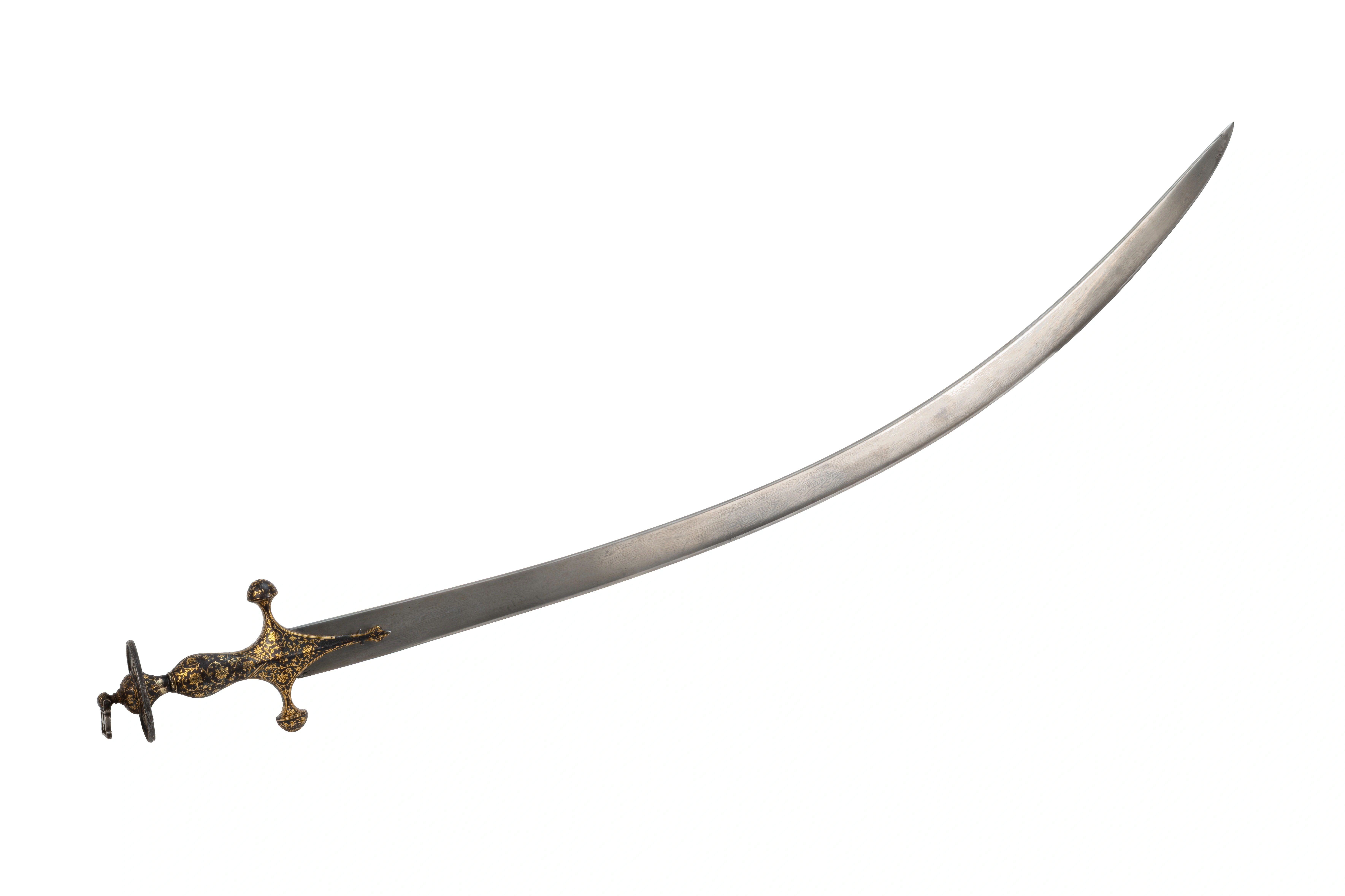
Gilded Sabre with an Islimy Pattern
17th century. Central Asia. Steel. 91 × 10 cm
Audio guide
Audio available in: RU
Description
This 17th-century sabre represents a refined synthesis of military function and Islamic artistic expression.
The hilt immediately draws attention with its intricate decoration. It is covered with islimi ornament – flowing vegetal patterns that, in Islamic art, symbolize the infinite nature of divine creation rather than mere embellishment.
The gilded decoration is executed in the koftgari technique, where fine gold wire is inlaid into a textured steel surface. This labor-intensive process indicates both high craftsmanship and elite ownership. Such sabres often functioned not only as weapons but also as ceremonial or diplomatic objects.
The curved blade reflects the optimized design for mounted combat, enabling powerful slicing strikes from horseback – a defining feature of Central Asian warfare.
The disc-shaped pommel, typical of the Indo-Persian tradition, secured the grip and improved handling. A small loop near it was used to attach a wrist strap.
This sabre is therefore not merely a weapon, but a cultural artifact embodying the intersection of Turkic, Persian, and Indian traditions, where martial objects were also carriers of aesthetic and symbolic meaning.