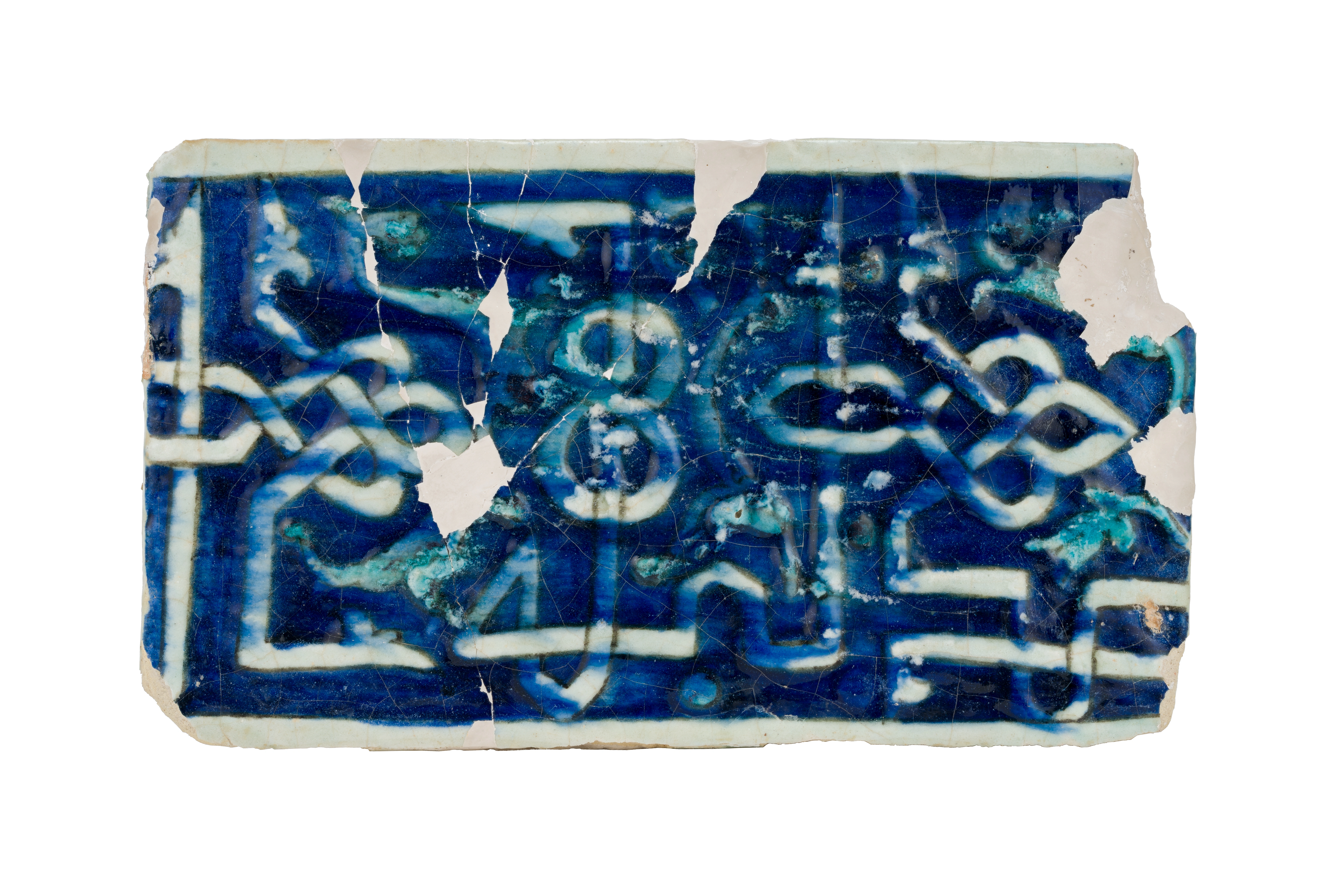
Architectural Tile Fragment
Early 14th century. Mawarannahr. Ceramic. 34.8 × 20.2 cm
Audio guide
Audio available in: UZ
Description
This fragment of a ceramic architectural tile dates to the early 14th century and comes from the region of Mawarannahr.
Tiles of this type were used to decorate monumental buildings such as mosques, madrasas, and mausoleums. They formed continuous decorative bands across walls and portals.
The main decorative feature is an inscription executed in Kufic script. The letters are intertwined in a complex geometric arrangement known as “interlaced Kufic,” where writing and ornament merge into a unified decorative pattern.
The white inscription stands out against a deep blue and turquoise glazed background. This striking color combination became one of the defining visual characteristics of Central Asian architecture, especially during the Timurid period.
Such tiles were often arranged as epigraphic friezes containing Qur’anic verses, blessings, or commemorative inscriptions.
Fragments like this recall the decorative programs of famous monuments such as the Shah-i Zinda complex in Samarkand, where glazed ceramic inscriptions transform architecture into a luminous surface of color, calligraphy, and geometry.