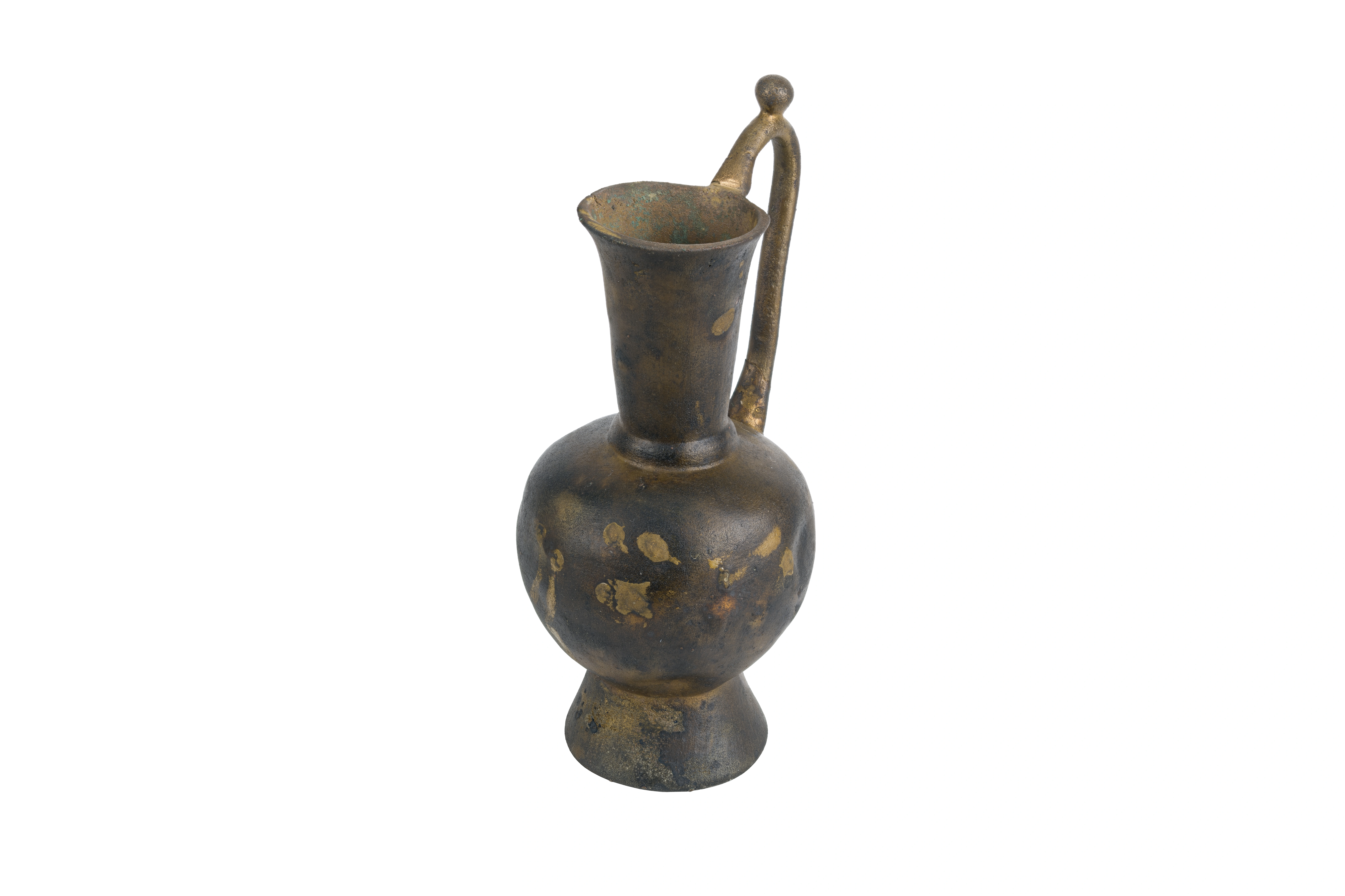
Obdasta (Water Ewer)
10th–11th centuries СЕ. Mawarannahr. Brass. 17.4 × 7.7 cm
Audio guide
Description
This vessel’s shape immediately suggests its function. The elongated neck, rounded body, and curved handle are designed to balance stability with precise control of pouring water.
This water ewer was produced in Mawarannahr during the 10th–11th centuries, a period marked by the growth of cities and the formation of shared urban practices. Such vessels were used for washing hands and face–an essential act connected both to everyday hygiene and to Islamic religious prescriptions. They were commonly found in private homes, near mosques, and in public and educational spaces.
Look closely at the metal surface. The traces of corrosion, and casting irregularities indicate prolonged use. Despite this wear, the form remains carefully calculated: the broad body holds sufficient water, while the narrow neck allows it to be poured accurately and sparingly.
This obdasta illustrates a key feature of the First Renaissance in Central Asia,the integration of practical function, technological skill, and religious norms into the fabric of daily urban life.