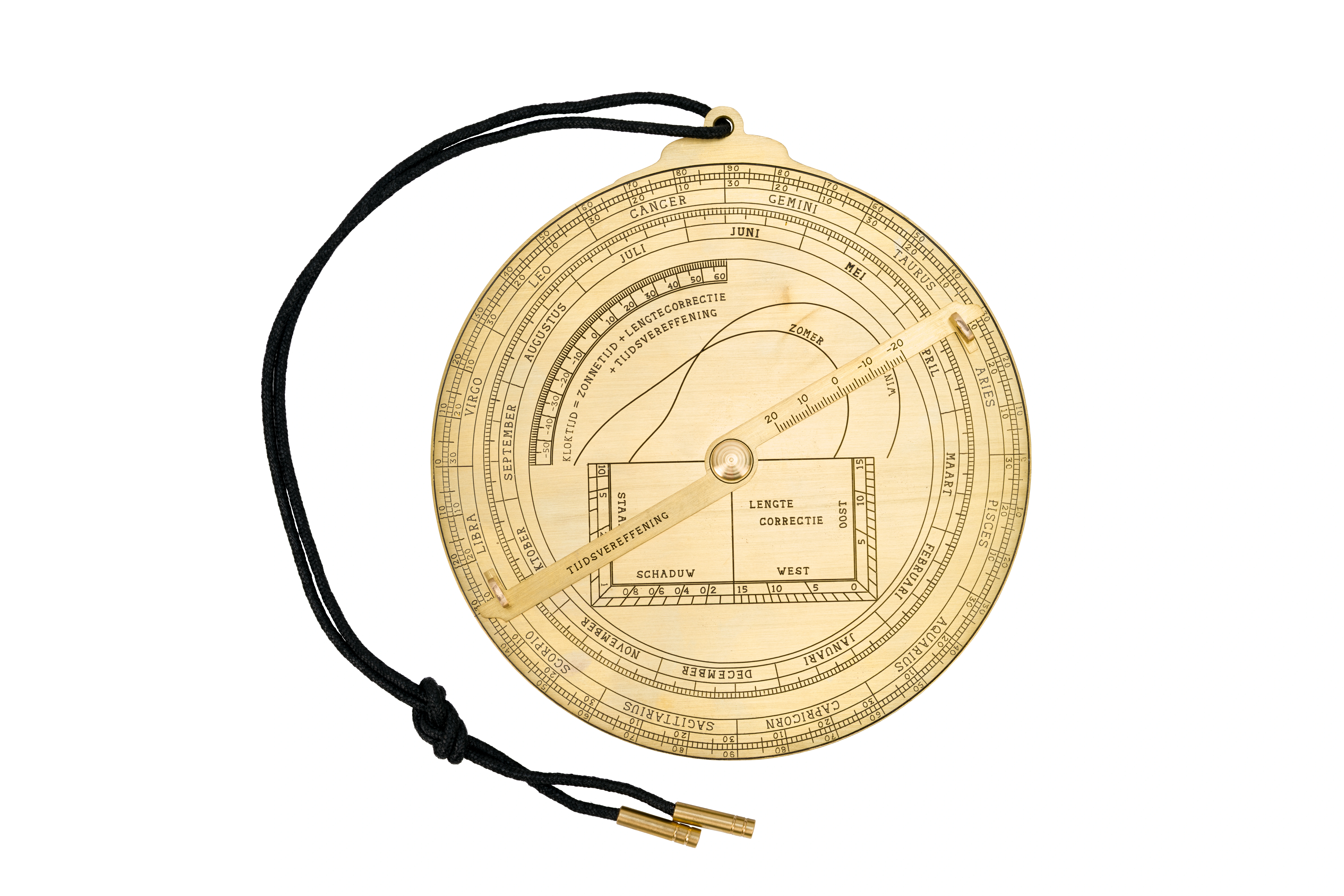
Astrolabe
Central Asia. 19.5 × 17.9 cm. Replica
Audio guide
Description
This astrolabe represents one of the most important scientific instruments of the medieval Islamic world.
Astrolabes were used to observe the movement of celestial bodies, determine time, calculate the altitude of the Sun and stars and orientation in space.
Combining astronomy, mathematics, and geography, the astrolabe allowed scholars to determine latitude, calculate prayer times and find the direction of Mecca. Instruments of this kind formed the foundation of scientific practice in Central Asia during the 10th and 11th centuries, a region known for its outstanding astronomers and scholars.
The structure of the astrolabe reflects a vision of the space as an ordered and measurable system. Engraved scales, rotating elements, and geometric grids transformed the sky into a precise computational model.
Even as a replica, this object conveys the sophistication of medieval scientific thought, when astronomy was not abstract theory but a practical discipline closely connected to daily life, navigation, and religious practice.