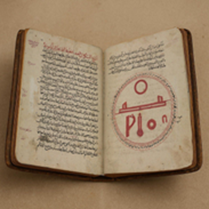
“Kitab al-kamil fi san'at al-asturlab ash-shimoli wal-l-janubi”
Ahmad al-Farghani. Calligrapher: Umar ibn Muhammad ibn Talha. Naskh script. Arabic. 30 × 20 cm. Bodleian Library (No. Or 14270), Oxford,UK. Replica
Audio guide
Audio available in: UZ
Description
This object is a reproduction associated with the scholarly legacy of Ahmad al-Farghani, a 9th-century astronomer from the Ferghana Valley.
His works contributed significantly to the understanding of the structure of the celestial sphere and the measurement of the Earth. His writings provided methods for calculating the positions of celestial bodies.
The manuscript belongs to the tradition of treatises on the astrolabe—one of the most important scientific instruments of the medieval world. The astrolabe was used to determine time, navigate using stars, and conduct astronomical observations.
The diagram visible on the page represents a geometric projection of the celestial sphere onto a plane, a fundamental principle behind such instruments.
Written in naskh script, the manuscript reflects the need for clarity and precision in scientific transmission.
Although the original is preserved in Oxford, the intellectual framework it represents was shaped in Central Asia, where astronomy combined theoretical insight with practical application.