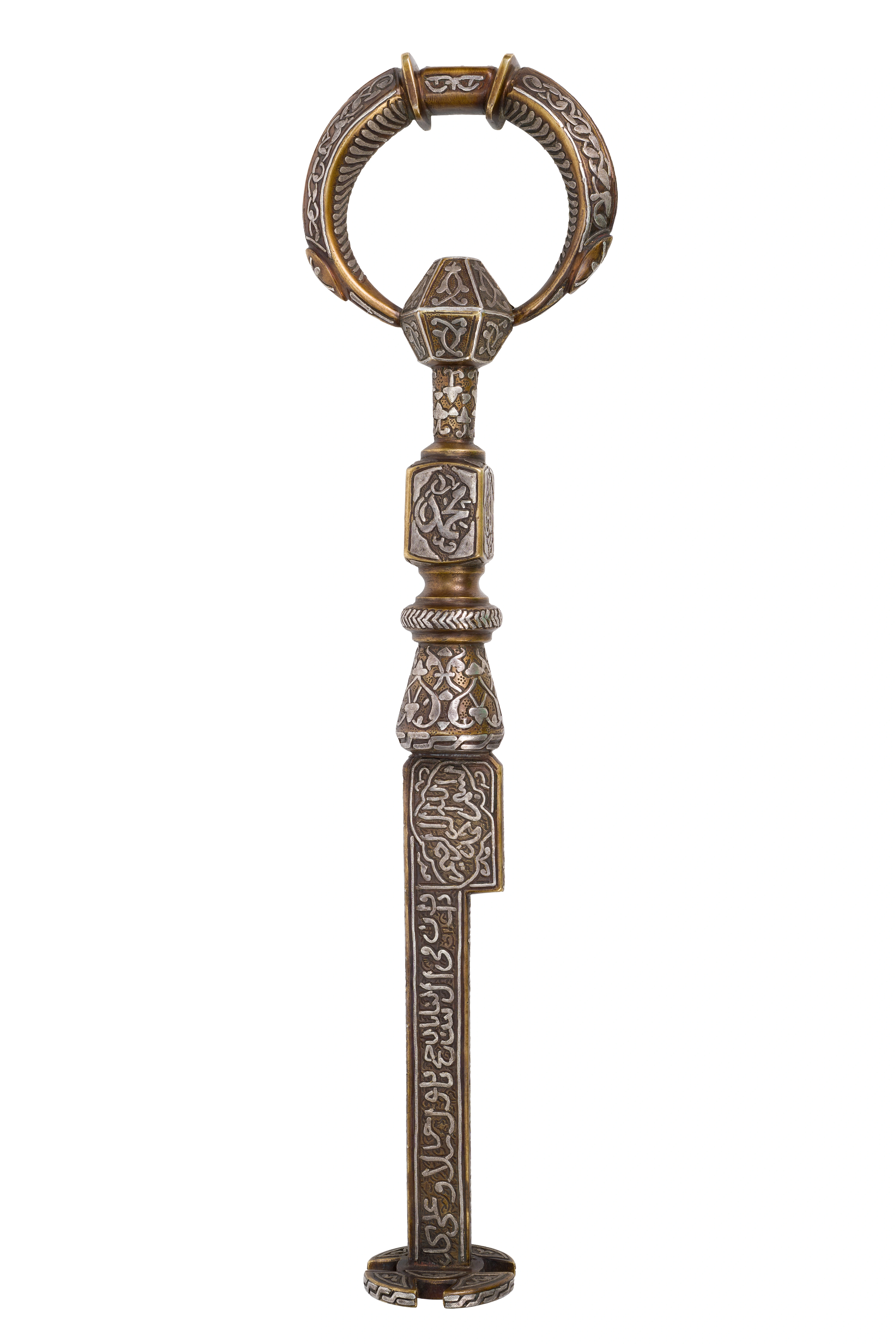
Key to the Kaaba
Engraved with verse 27 of Surah Al-Hajj. Mamluk Period. 13th century СЕ. Brass, silver. 43.5 × 11.2 cm. Museum of Islamic Art, Jeddah, Saudi Arabia
Audio guide
Description
This is a key to the Kaaba, the central sanctuary of Islam in Mecca. It dates to the 13th century and is associated with the Mamluk period.
The key’s elongated vertical form and large ring finial give the object both symbolic and ceremonial presence. Such monumental keys were not only functional objects but also powerful signs of authority and custodianship over one of the most sacred spaces in Islam.
The key is made of brass with silver inlay. Its surface is engraved with inscriptions in thuluth script. Along the shaft appears verse 27 of Surah al-Hajj: “And proclaim to the people the pilgrimage; they will come to you on foot and on every lean camel from every distant pass.” The verse emphasizes the universality of pilgrimage and the unity of the Muslim community.
The names “Allah” and “Muhammad,” as well as the phrase “Allahu akbar,” appear on different parts of the key. These inscriptions both decorate and sacralize the object, transforming it into a material expression of access to a space of profound religious significance.
Within the exhibition section “The Spread of Islam in Central Asia,” this key symbolizes the connection between distant regions of the Islamic world and the sacred center of pilgrimage, linking diverse territories within a shared spiritual and cultural sphere.