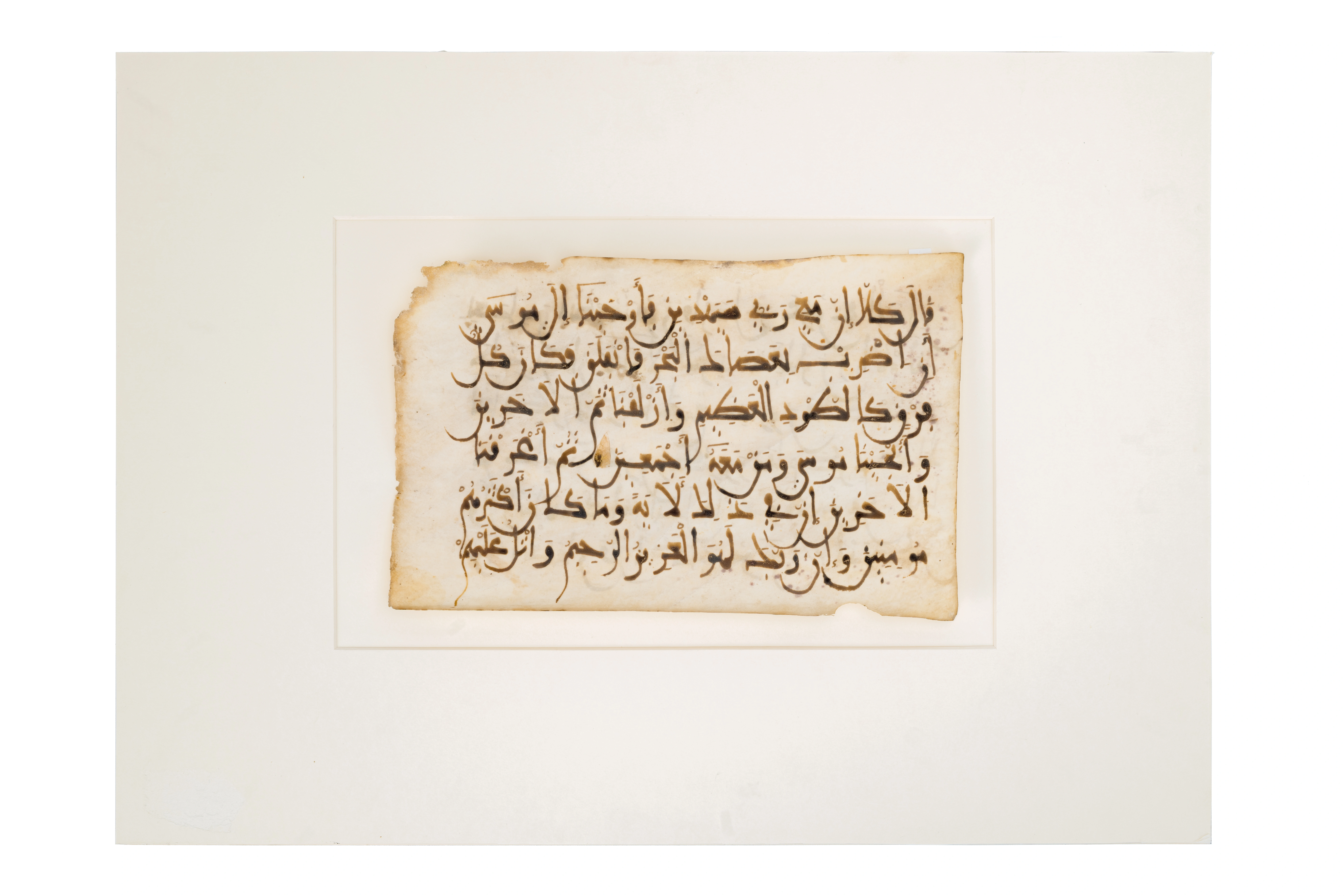
Folio from the Holy Qur’an
Surah ash-Shuʼara, verses 62–69 (partly). Naskh script. 11th–12th centuries CE. 18.9 × 28.7 cm. From the collection of the Center of Islamic Civilization in Uzbekistan
Audio guide
Description
This 11th–12th century folio demonstrates the definitive establishment of naskh script as the primary standard of Qur’anic book production. It contains verses 62–69 from Surah al-Shu‘ara’, recounting the episode of Moses and the crossing of the sea, including the declaration of trust: “Indeed, my Lord is with me; He will guide me.”
The compact format allows dense yet legible arrangement of text. Naskh, with its rounded and fluid forms, differs markedly from earlier angular Kufic. Connected letters, rhythmic lines, and red diacritical marks ensure clarity of recitation.
The term naskh derives from the verb “to copy” and also carries the sense of “superseding.” Over time it replaced earlier scripts in manuscript culture. In the 10th century, the calligrapher Ibn Muqla systematized it through a proportional canon, establishing a standardized model.
Its readability, efficiency, and balanced proportions made it universal. Today, most printed editions of the Qur’an worldwide employ variations of naskh.
This folio exemplifies how theological meaning, script reform, and aesthetic clarity converged during the First Renaissance of Islamic civilization.