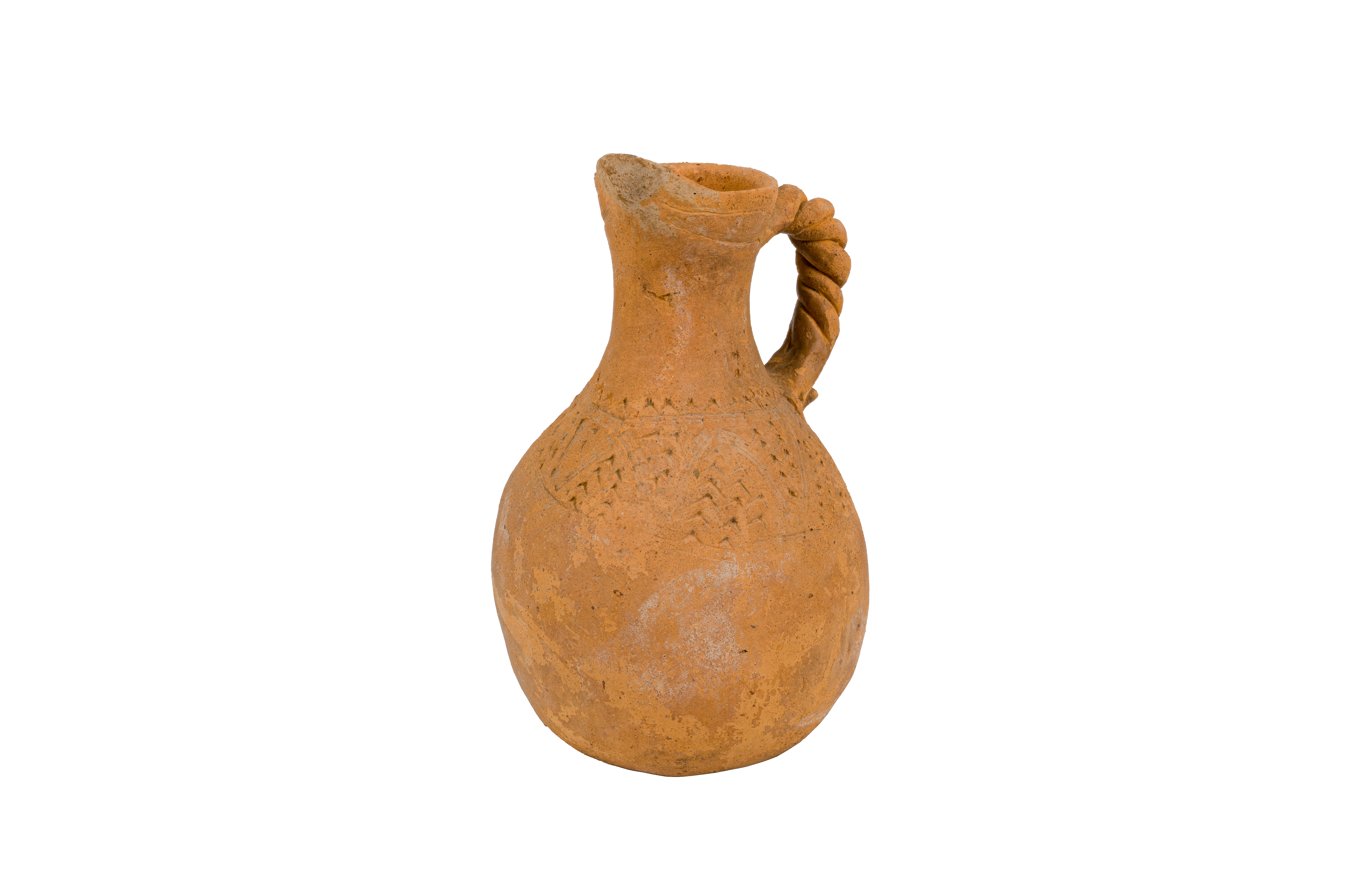
Jug
Late 9th–10th century CE. Mawarannahr. Ceramic. 21 × 13.2 cm
Audio guide
Description
This ceramic jug dates from the late ninth to the tenth century and originates from Mawarannahr . It belongs to the Samanid period, often described as a “golden age” of medieval Central Asia, when cities of the region flourished as centers of trade, scholarship, and craftsmanship.
The vessel’s form is carefully designed for everyday use. Its rounded body rises into a narrow neck with a small spout, allowing liquid to be poured easily and precisely. Jugs of this type were commonly used for water or wine.
Decorative patterns can be seen on the shoulder of the vessel. The dotted and geometric ornament was created using stamped decoration. Craftsmen pressed carved wooden or bone stamps into the soft clay before firing, producing repeating motifs across the surface.
The handle is also notable. It is shaped like a twisted rope, a design that imitates braided cords once used to secure vessels. At the same time, this form made the handle easier to grip when the jug was wet.
The jug was made of engobed ceramic. Before firing, the surface was covered with a thin layer of refined clay called engobe, which created a smoother and lighter surface for decoration.
Similar vessels have been discovered in archaeological excavations of ancient cities such as Afrasiab–the medieval site of Samarkand–illustrating the high level of pottery production in Central Asia during this period.