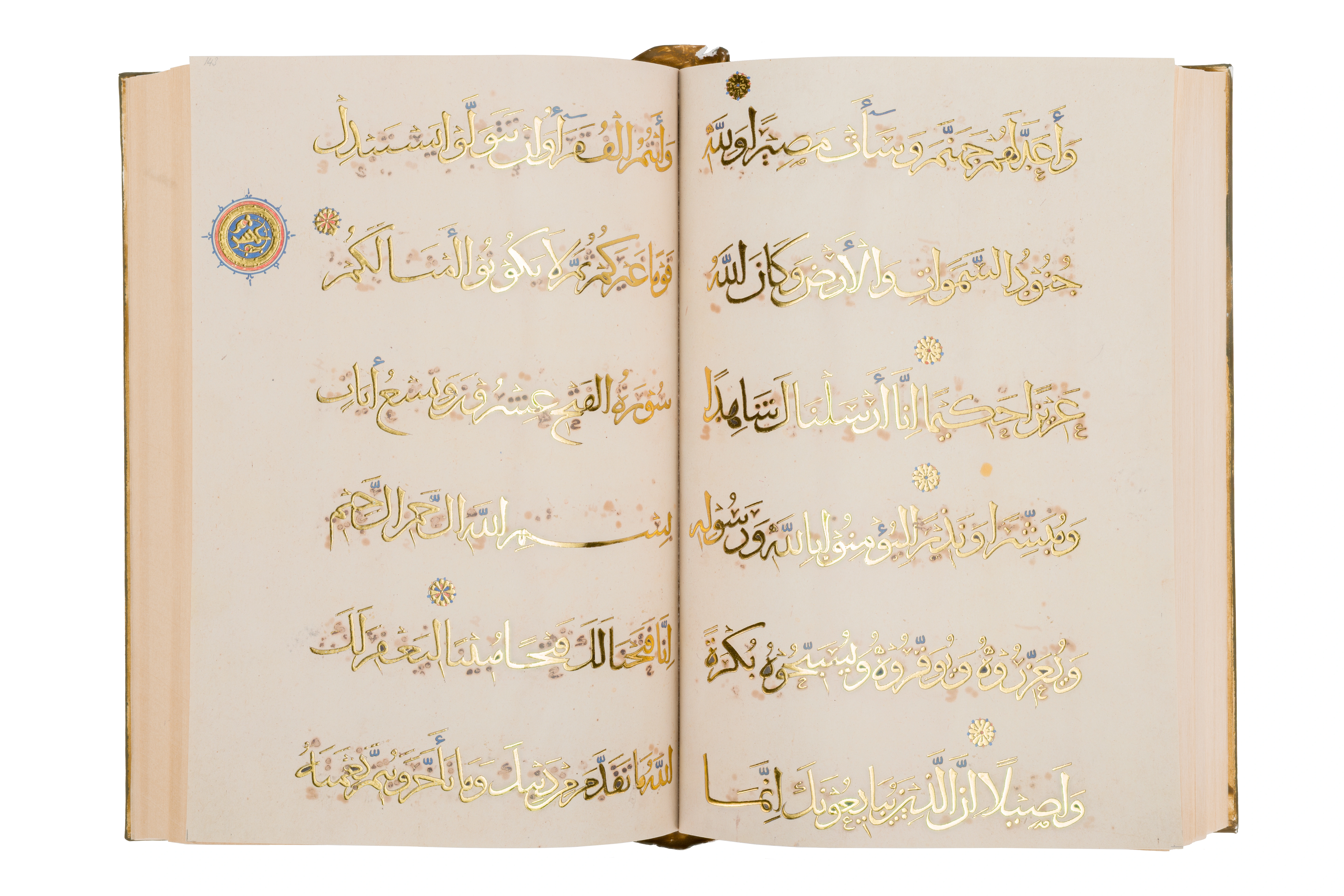
Qur’an of Sultan Baybars
Calligrapher: Muhammad ibn al-Wahid. 14th century / 1315 CE. 29.5 × 19.5 cm; 1094 folios. BL Add MS 22406, London
Audio guide
Description
This is one of the most monumental Qur’anic manuscripts of the medieval Islamic world — the Qur’an of Sultan Baybars. It was created in 1315 by order of the Mamluk Sultan az-Zahir Baybars, a ruler who played a key role in protecting the Islamic world from the Crusaders and Mongols.
This manuscript is extraordinary in scale, comprising over one thousand folios. The text was executed in gold ink by the master calligrapher Muhammad ibn al-Wahid, whose precise control of proportion and rhythm reflects the highest standards of Qur’anic calligraphy. The illumination enhances the sacred text without overwhelming it, guiding the reader toward contemplation rather than display.
Such Qur’ans were not intended for private devotion. They were created for major mosques and madrasas as public symbols of piety, authority, and divine legitimacy. In the Mamluk and Golden Horde era, the Qur’an functioned as a visual and spiritual anchor of Islamic unity.
This manuscript is more than a book, it is a material expression of faith, power, and artistic excellence intertwined.