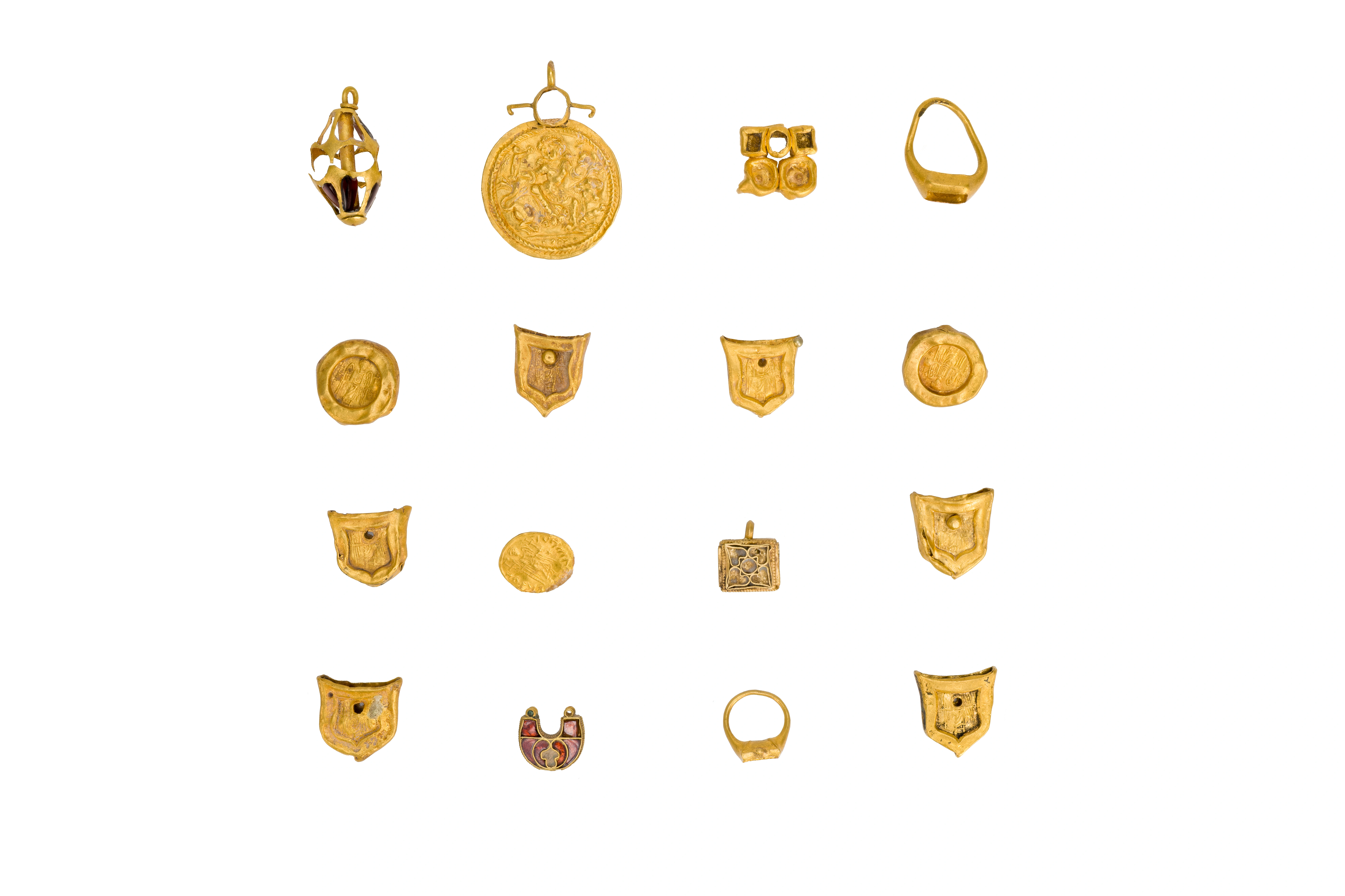
Objects by Artisans of the Turkic Khaganate (23 pcs)
6th century CE. Mai village. Tashkent region. Gold. Dimensions vary
Audio guide
Audio available in: UZ
Description
This collection of gold objects dates to the 6th century, the period of the Turkic Khaganate–one of the earliest large nomadic empires of Central Asia. The items were discovered in the region of ancient Chach, corresponding to the modern Tashkent oasis, which already in the pre-Islamic period functioned as an important center of craftsmanship and trade.
The assemblage includes small plaques, pendants, and decorative elements made of gold. Many are shield-shaped, circular, or medallion-like. Some display relief imagery–possibly anthropomorphic figures or symbols of authority. These objects were sewn onto garments or worn as ornaments, forming a visual language of status and elite identity.
Despite their small size, the objects demonstrate advanced techniques such as hammering, embossing, and fine metalworking. This reflects the high level of craftsmanship in Central Asia as early as the 6th century. Notably, they combine nomadic steppe traditions with influences from sedentary cultures, especially Sogdian and Iranian.
Their function was not purely decorative. In pre-Islamic belief systems, gold symbolized the sun, eternity, and protection. Such items could serve an apotropaic function, acting as protective amulets, particularly in funerary contexts.
This hoard reflects the complex cultural landscape of pre-Islamic Central Asia, where nomadic Turkic traditions, urban Sogdian culture, and Silk Road connections intersected. Within this environment, the artistic and technological foundations of later Islamic culture in the region were formed.