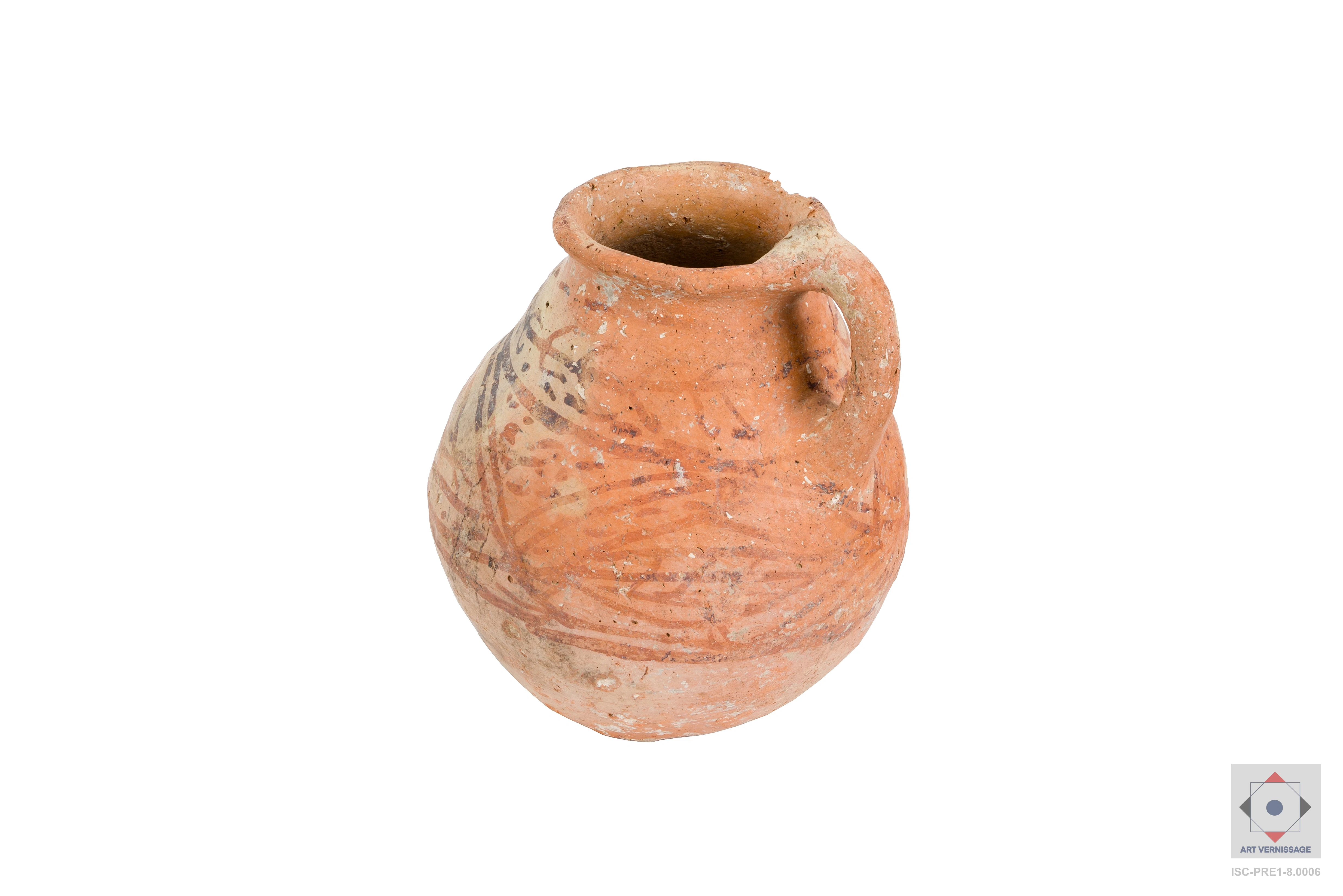
Jug with Handle
4th–1st centuries BCE. Fergana. Ceramic. 16.7 × 14.6 cm
Audio guide
Audio available in: UZ
Description
This small ceramic jug originates from the Fergana Valley and dates to the 4th–1st centuries BCE. It belongs to the pre-Islamic period of Central Asia, when early agricultural societies and regional connections were already forming.
The vessel’s a rounded body, short neck, and a single handle reflects functional design. It could be easily held with one hand, and its volume was suitable for storing water or other liquids. Slight asymmetry in the body suggests hand-building or the use of a slow potter’s wheel.
The painted decoration is particularly notable. Over a light slip background, red-brown geometric patterns are applied. Lines, zigzags, and diagonal motifs create a dynamic rhythm and likely carried symbolic meanings related to water, fertility, and natural cycles – essential concepts for early agrarian communities of the region.
The surface shows visible traces of age: wear along the rim, abrasions, and discoloration. These features confirm the authenticity of the object and its prolonged everyday use.
This jug represents an independent pre-Islamic artistic tradition of Central Asia, already demonstrating key elements that would later define the region’s material culture: a strong preference for ornament, attention to form, and a close connection to the natural environment. Such objects laid the foundation for the flourishing of ceramics in the Islamic period.