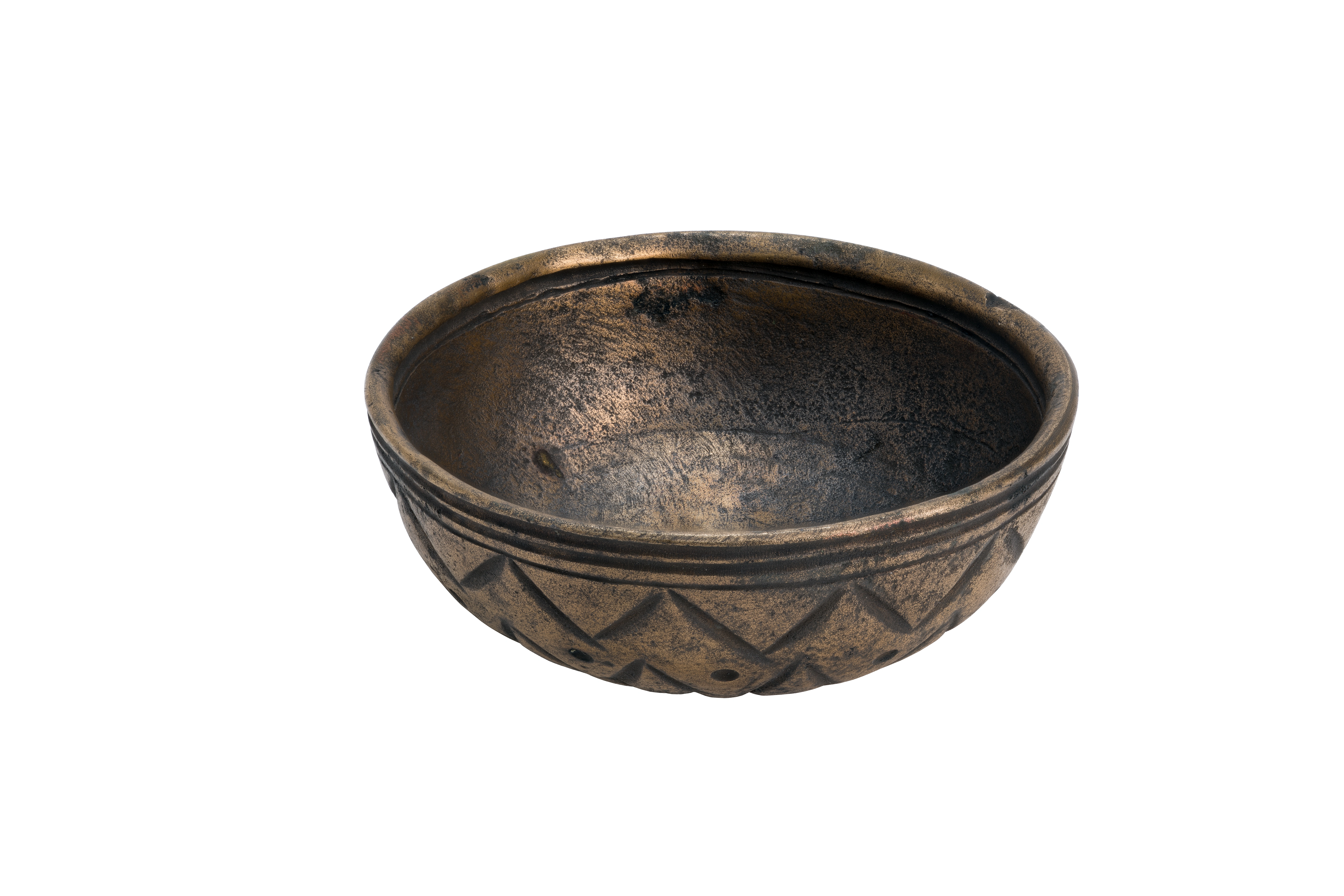
Small bowl
7th century CE. Central Asia. Bronze. 3.1 × 7.7 cm
Audio guide
Description
You are looking at a 7th-century bowl created in Central Asia during the flourishing of the urban cultures of Sogdiana and adjacent regions.
Its form is simple and harmonious: a hemispherical body, a smoothly finished rim, and a restrained geometric ornament on the exterior. Yet behind this simplicity lies a developed metallurgical tradition. The bowl was produced using traditional metalworking techniques. Its surface was refined by hammering, while the ornament was applied through engraving or stamping according to a pre-marked design.
In the 7th century, bronze was a widely used material, valued for its strength and resistance to corrosion. Such vessels were used for drinking water, milk, kumis as well as in ritual and communal dining practices.
This bowl reflects the continuity of form: its silhouette has changed little over the centuries and remains recognizable in the traditional culture of the region.