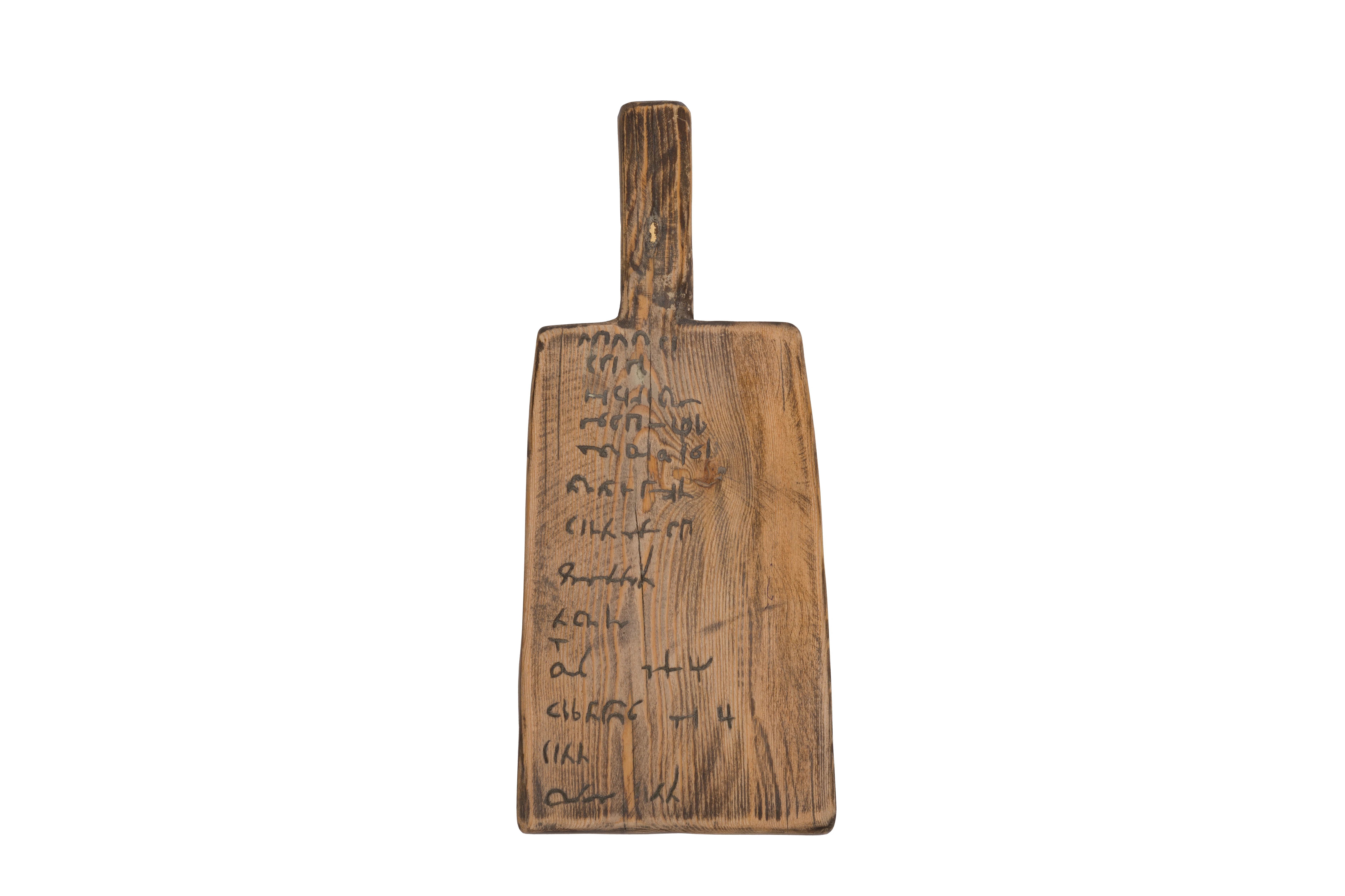
Khorezmian Inscription on a Wooden Tablet
1st century BCE. Toprak-kala, Khorezm. Wood. 29.3 × 12 × 2 cm
Audio guide
Description
This wooden tablet bearing an inscription was discovered at the fortress of Toprak-kala, one of the major centers of ancient Khorezm. Construction of the complex began in the 1st century BCE, and in later centuries it served as a royal residence.
The text is written in the Khorezmian script, a writing system derived from Aramaic and adapted to the local language. Such inscriptions were applied in ink to wooden tablets or bark and functioned as administrative documents, recording taxation, land management, and economic transactions.
Archaeological excavations at Toprak-kala have revealed dozens of similar documents, demonstrating the existence of a developed bureaucratic and written tradition. The evolution of letter forms, including the transformation of the letter “aleph,” reflects the gradual divergence of Khorezmian writing from its Aramaic prototype.
This object illustrates the advanced level of state administration in ancient Khorezm.