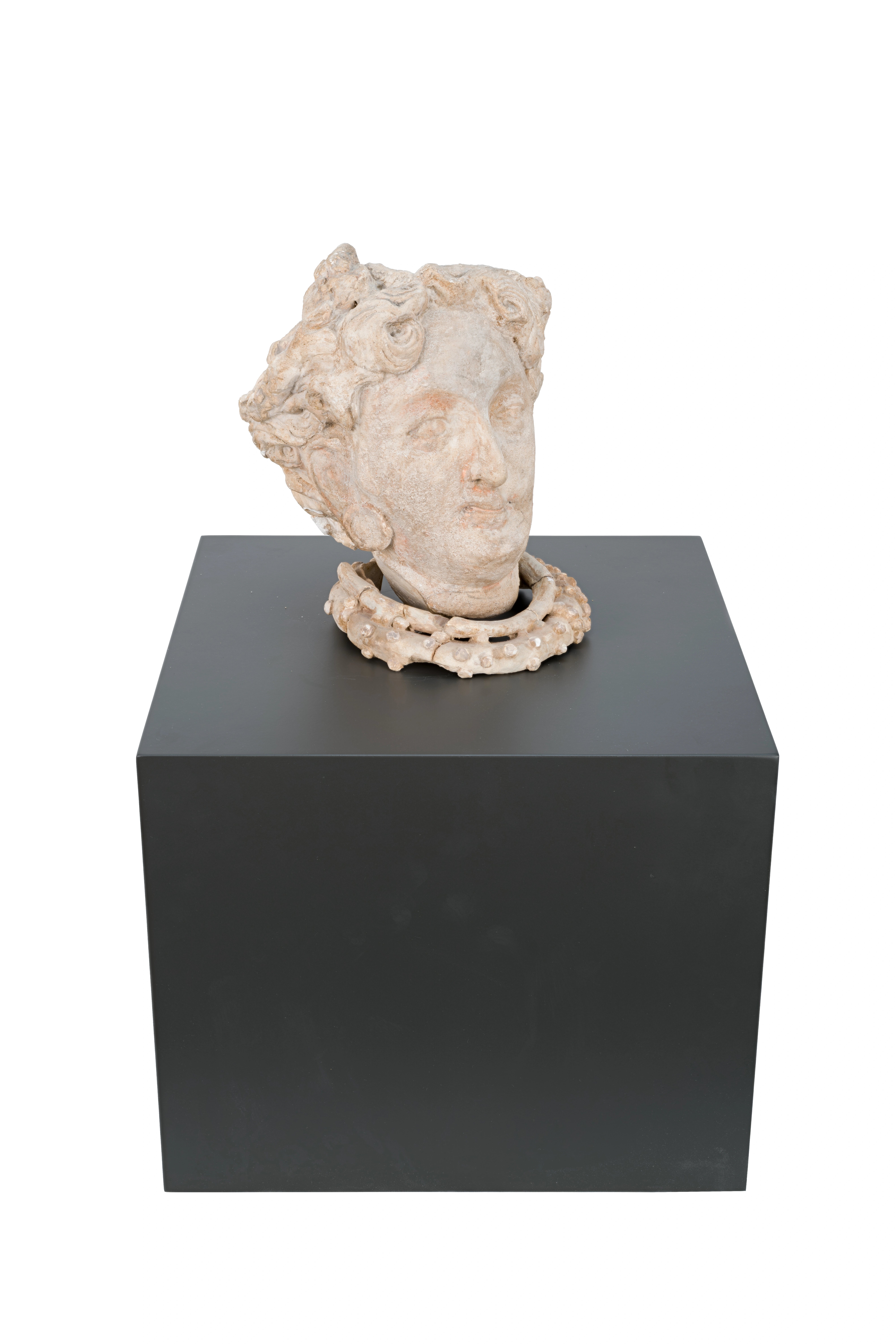
Head of the Goddess Devata
1st–2nd centuries CE. Dalvarzintepa, Surkhandarya Region. 22.5 × 21 × 19 cm. Replica
Audio guide
Description
This head of a Devata was discovered in the temple complex of Dalverzintepa and dates to the 1st–2nd centuries CE, during the flourishing of the Kushan Empire.
The fragment was uncovered during archaeological excavations beneath layers of sand, gravel, and soil that had covered the temple structures. It was found lying face down on a staircase near a platform, suggesting the destruction and subsequent burial of the sanctuary.
The figure is depicted with curly hair and traces of a wreath. The facial modeling is soft yet expressive. Remains of polychromy are still visible: the eyebrows, eye contours, and upper lip were accentuated with dark pigment, while the lips once bore a pinkish-red tone. The slightly parted mouth conveys a sense of animation, as though the figure were speaking or singing.
Images of devatas—celestial beings within the Buddhist pantheon—are characteristic of Bactrian art, where Indian religious iconography merged with local artistic traditions and Hellenistic sculptural influences.
This fragment attests to the rich spiritual life of ancient Bactria and to the high level of monumental art achieved in the region.