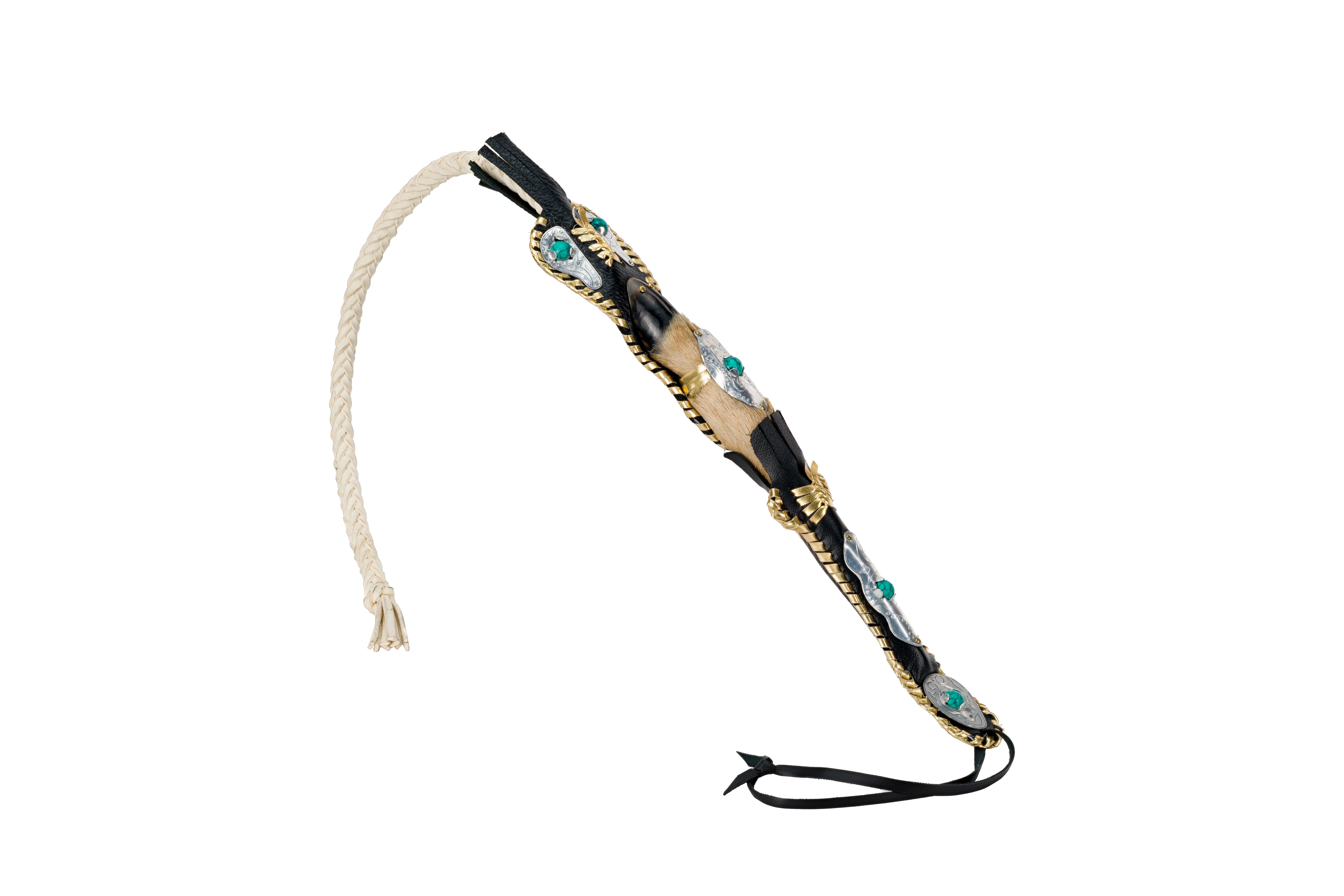
Whip
19th–20th centuries. Central Asia. Leather, aluminum. Length: 82 cm
Audio guide
Audio available in: RU
Description
This object is a kamchi, a traditional riding whip widely used among the peoples of Central Asia.
Although it appears to be a simple riding tool, within nomadic culture the whip held deeper symbolic meaning. It was associated with courage, strength, and authority, serving as an important attribute of the mounted warrior.
During the period of the Uzbek Khanates including the Bukhara Emirate and the Khiva and Kokand Khanates the kamchi could also function as a symbol of status. Such items were sometimes presented as honorary gifts to respected riders, warriors, or distinguished guests.
A traditional kamchi consists of two main parts: a handle and a braided leather lash. Handles were often crafted from wood, bone, or horn and decorated with metal fittings and ornamental stones.
This example features decorative elements and stone inlays, suggesting it may have served a ceremonial or representative purpose rather than purely practical use.
In nomadic traditions, the whip could also carry protective meaning. It was sometimes hung near the entrance of a dwelling or beside a child’s cradle as a talisman believed to ward off harmful spirits.