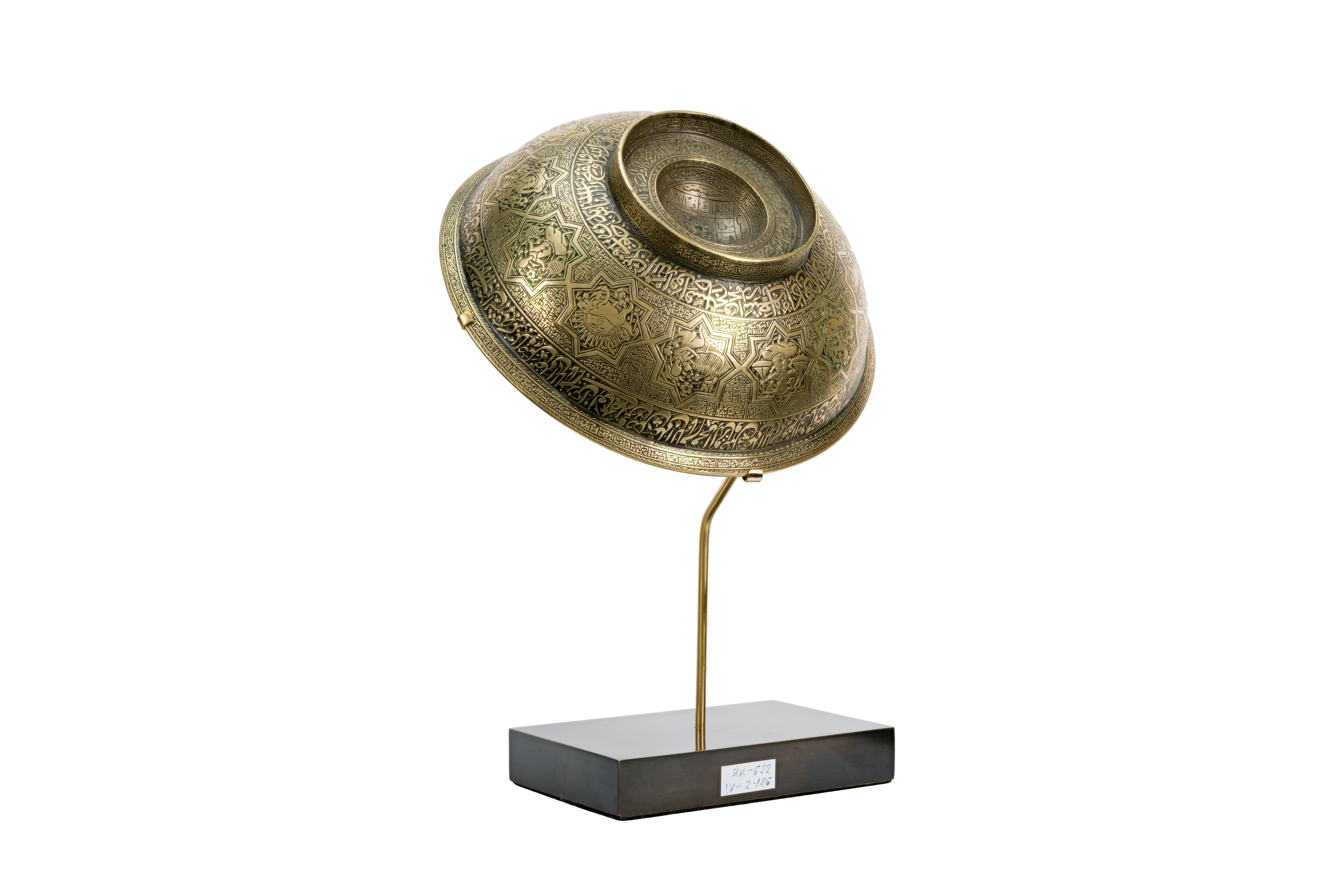
Bowl
1643–1644. Central Asia. Copper; chased and engraved. 7.5 × 22 cm
Audio guide
Audio available in: RU
Description
This copper bowl from the mid-seventeenth century CE represents a refined example of Central Asian metalwork.
Its entire surface is covered with intricate engraved ornamentation. This decorative technique, known in the region as kandakorlik, was widely practiced by craftsmen in major artistic centers such as Bukhara and Samarkand.
The decoration consists of complex interlacing geometric and vegetal motifs. Such patterns are characteristic of Islamic ornamental art, where rhythm, symmetry, and balance play a central aesthetic role.
Objects of this type were used both in everyday life and during festive gatherings. Copper vessels were valued for their durability and their suitability for detailed engraving.
The precise date of 1643–1644 makes this object particularly noteworthy. Exact dates on metal vessels are relatively rare and are often associated with inscriptions added by the craftsman or commissioned by a patron.
This bowl illustrates the high level of artistic craftsmanship achieved in Central Asia during the seventeenth century CE, when utilitarian objects were often transformed into sophisticated works of decorative art.