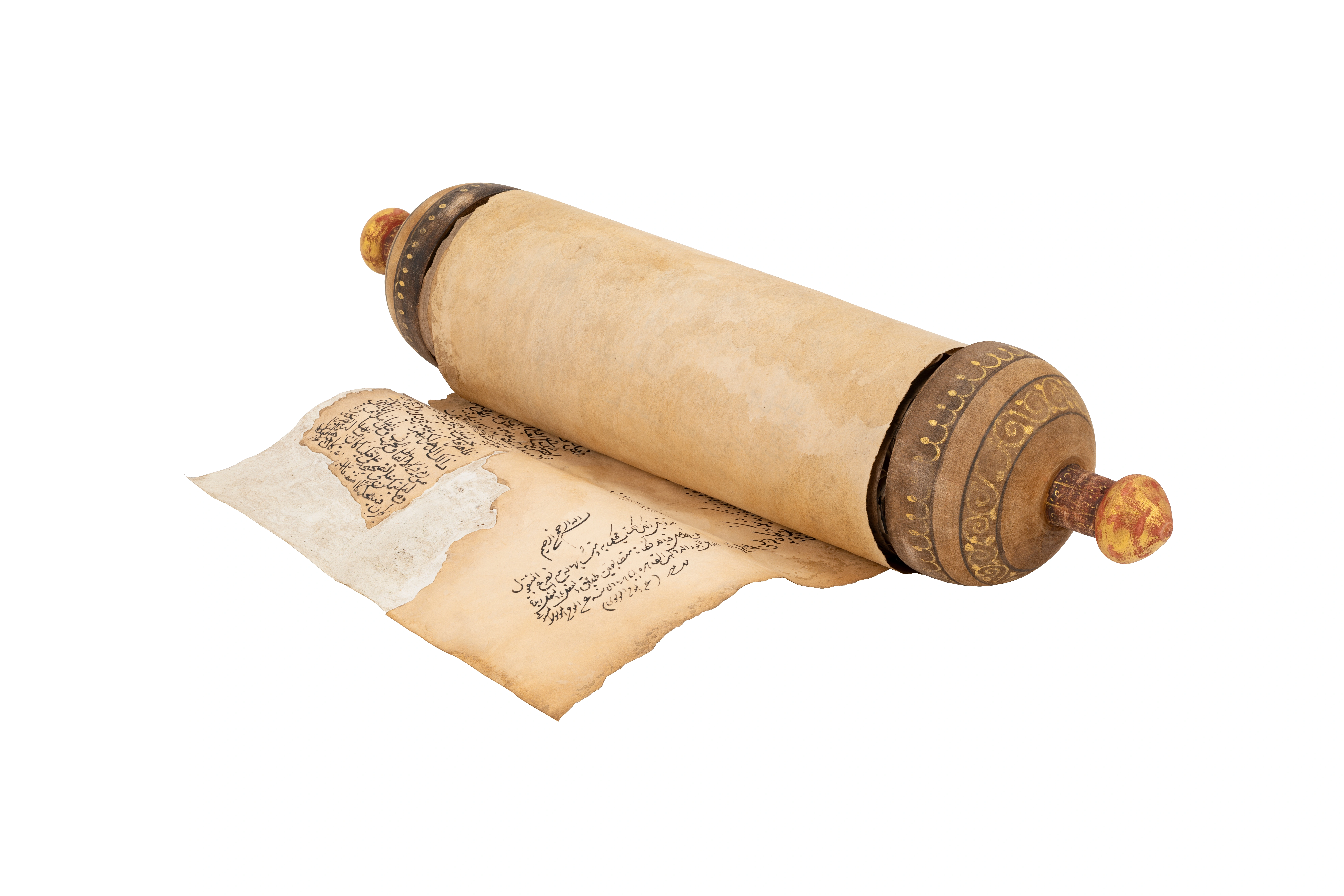
Waqfname of Gavharshad Begum
1426. Mashhad. Persian. Paper. 40 × 20 cm
Description
The scroll of Gawharshad Begum’s waqf deed brings us into the legal world of Timurid Khurasan, where charity was formalized through a precise juridical act. The document was drawn up in Mashhad in 1426 and assigned the revenues of lands, villages, and commercial properties to the Gawharshad Mosque within the Imam Reza complex.
Gawharshad Begum, wife of Shahrukh and one of the most influential patrons of the fifteenth century, appears here not only as a benefactor, but also as an autonomous subject of Islamic law. The scroll format was chosen deliberately: it was difficult to replace or alter unnoticed, making it suitable for a perpetual waqf.
The gilded wooden rollers with vegetal ornament protected the paper and made the document easier to unroll. The sheets show dense Persian text, the basmala, marginal notes, and attestations. Signatures, seals, and oblique annotations turn the document into public testimony. This waqf deed shows how women of the Timurid elite participated in construction, property management, and the support of learning, religion, and urban life. In it, social care, architectural patronage, and religious responsibility are joined into a durable system of urban memory and legal continuity across centuries.