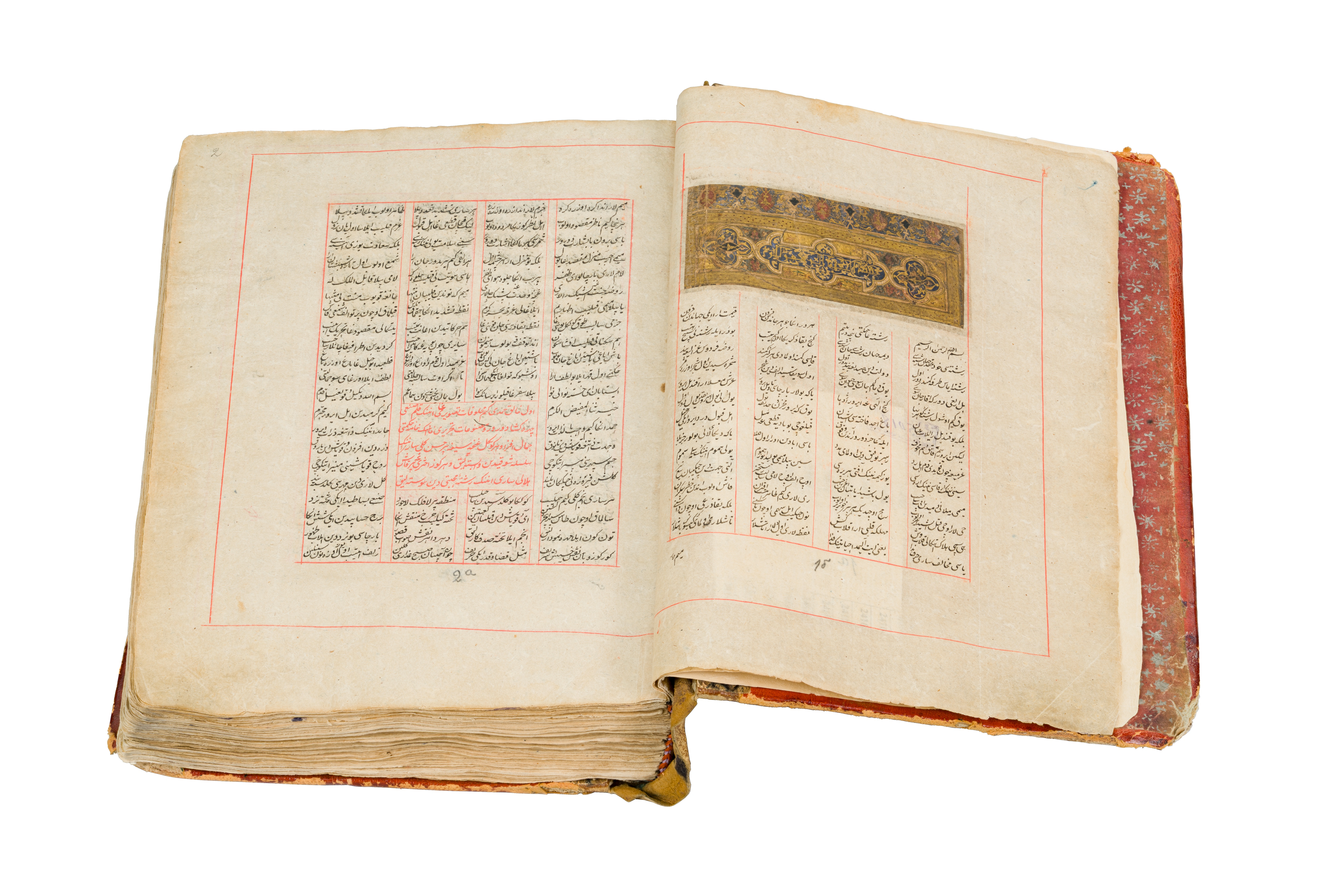
“Khamsa”
Alisher Navoi. Calligrapher: Abduljamil. Copied in 1485Central AsiaTurkic. Nastalik script. Oriental paper. 19 × 27.5 cm. Manuscript of the Institute of Oriental Studies, Academy of Sciences of Uzbekistan
Description
The open folios of this “Khamsa” immediately reveal the scale of a courtly manuscript: the text is arranged in four narrow columns, separated by fine golden lines, while the broad margins emphasize the ceremonial character of reading. This format was typical of monumental poetic works, where each page was perceived as an independent composition. Alisher Navoi completed his “Quintet” in 1485 as a Turkic response to the great Persian “Khamsas” of Nizami and Amir Khusraw Dihlavi.
This manuscript was copied in the same year by the calligrapher Abduljamil, and therefore belongs to the rare early copies close to the author’s own lifetime. For the culture of Central Asia, this was an event of exceptional importance: Navoi demonstrated that the Turkic language was capable of expressing the most complex philosophical, romantic, and heroic poetry.
Particularly striking are the tinted folios, the lapis-and-gold sarlavh, and the red leather binding with a flap, medallions, and corner pieces. Here, poetic text, calligraphy, gold, and binding function as a unified artistic program, created in the atmosphere of Timurid Herat and connected with the library culture of Sultan Husayn Bayqara’s court and his immediate literary circle in the late fifteenth century.