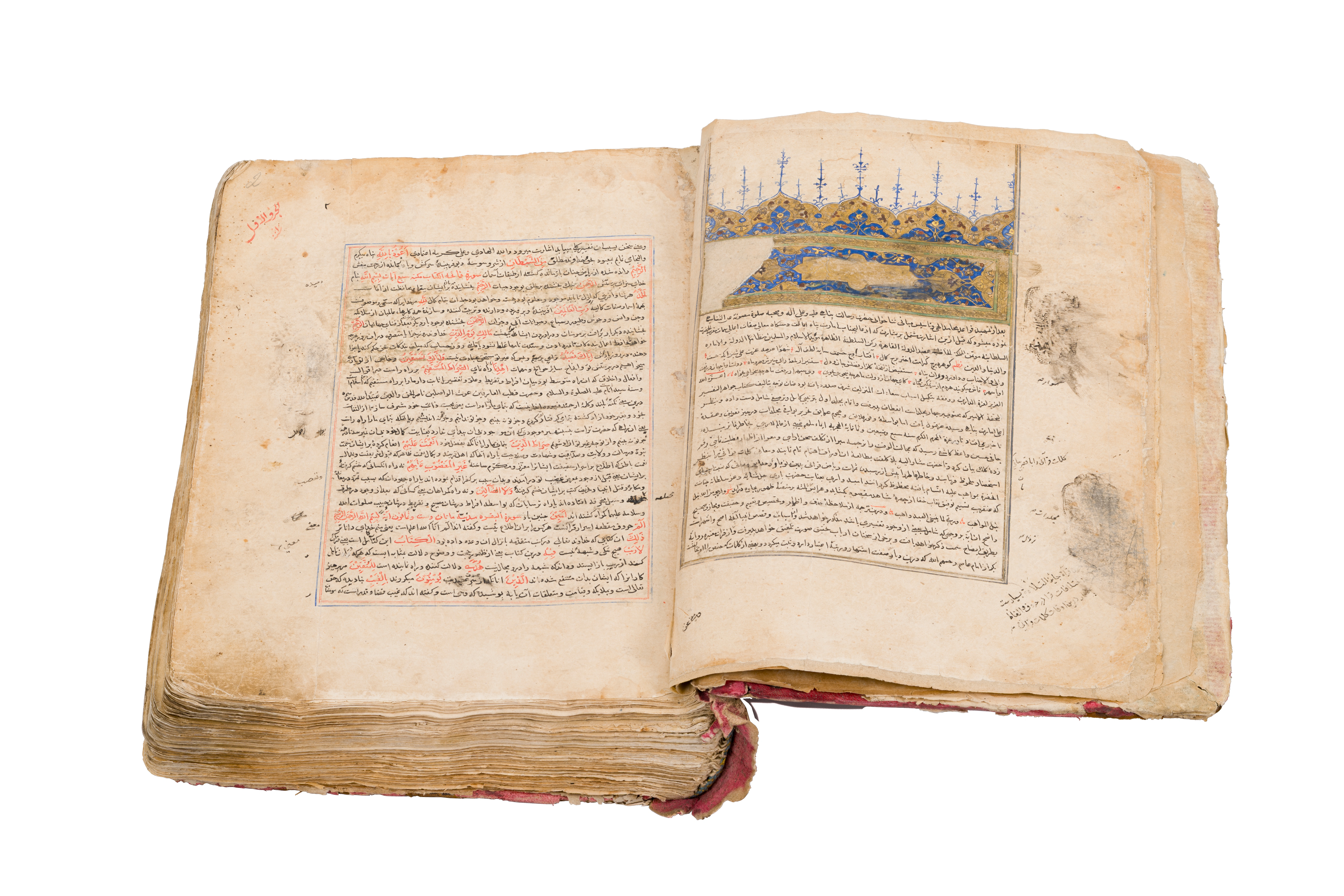
“Mavahib-i Aliyya”
Husayn Vaiz Kashifi. Calligrapher: Abd Allah ibn Mawlana Muhammad Saqi. Copied in 1697. Persian. Nastaliq script. Oriental paper. 29 × 21 cm. Manuscript of the Institute of Oriental Studies, Academy of Sciences of Uzbekistan
Description
The worn binding, traces of repeated opening, and dense marginal notes reveal that this manuscript was not merely preserved, but actively used within a living scholarly tradition. Before us is “Mavahib-i ‘Aliyya,” one of the best-known Persian commentaries on the Qur’an, composed by Husayn Vaiz Kashifi in the intellectual environment of late Timurid Herat.
The manuscript was copied in 1697 by the calligrapher Abdullah ibn Mawlana Muhammad Saqi in elegant nastaliq script. This flowing style was commonly associated with poetry and courtly literature, yet in Central Asia it was also employed for theological works, emphasizing the artistic value of the book itself.
On the right page survives a richly ornamented unvan, or illuminated heading, executed with gold and lapis-blue pigments. Such decoration suggests that the manuscript was produced for a patron of high status or for an important madrasa.
Originally composed during the age of Alisher Navoi, the work continued to be studied two centuries later, linking the intellectual traditions of Herat, Samarkand, and Bukhara within a shared Islamic civilizational space.