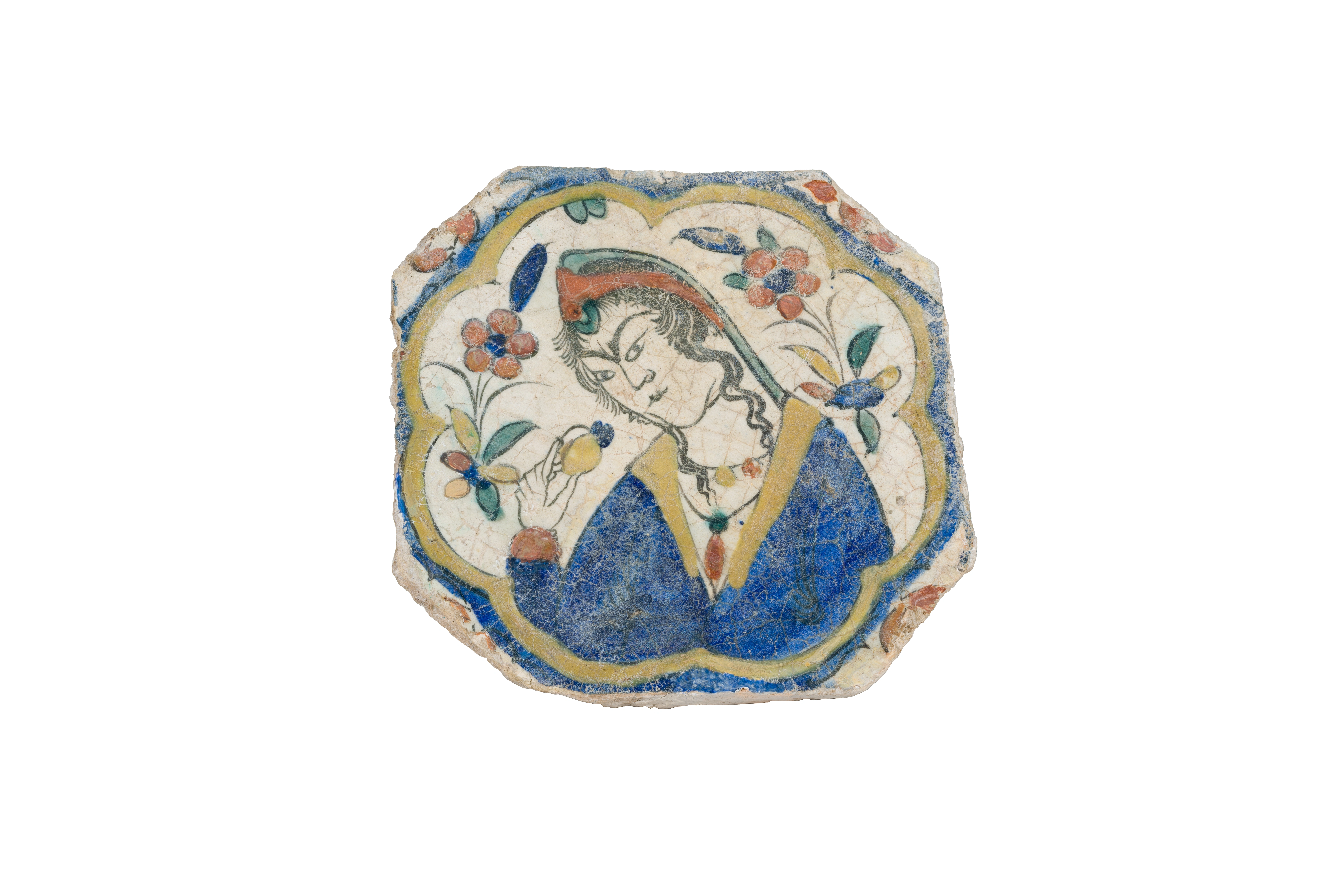
Tiles Depicting a Young Girl and Young Man
15th – 16th centuries CE. Central Asia. Ceramic. 16.4 × 16.7 × 1.8 cm. 16.8 × 16.8 × 1.9 cm
Audio guide
Description
These ceramic tiles from the 15th–16th centuries CE depict a young woman and a young man.
Tiles like these were used to decorate palace interiors, garden pavilions, and residential architecture. They formed colorful compositions that transformed architectural surfaces into richly decorated visual environments.
What makes these tiles particularly interesting is the depiction of human figures. While such imagery was uncommon in religious Islamic architecture, it appeared more freely in secular contexts, especially within palace settings.
The figure of the young woman is surrounded by floral motifs. Her image recalls themes found in Persian and Turkic poetry, where youth, beauty, and love were central subjects. During the time of Alisher Navoi, such themes were widely represented in miniature painting and decorative arts.
The ornamental frame and floral elements create a balanced composition. The palette of blue, green, and warm tones is characteristic of Central Asian ceramic decoration of the late Timurid and post-Timurid period.
These tiles reflect the artistic atmosphere of the time, when poetry, painting, and decorative arts developed in close dialogue with one another.