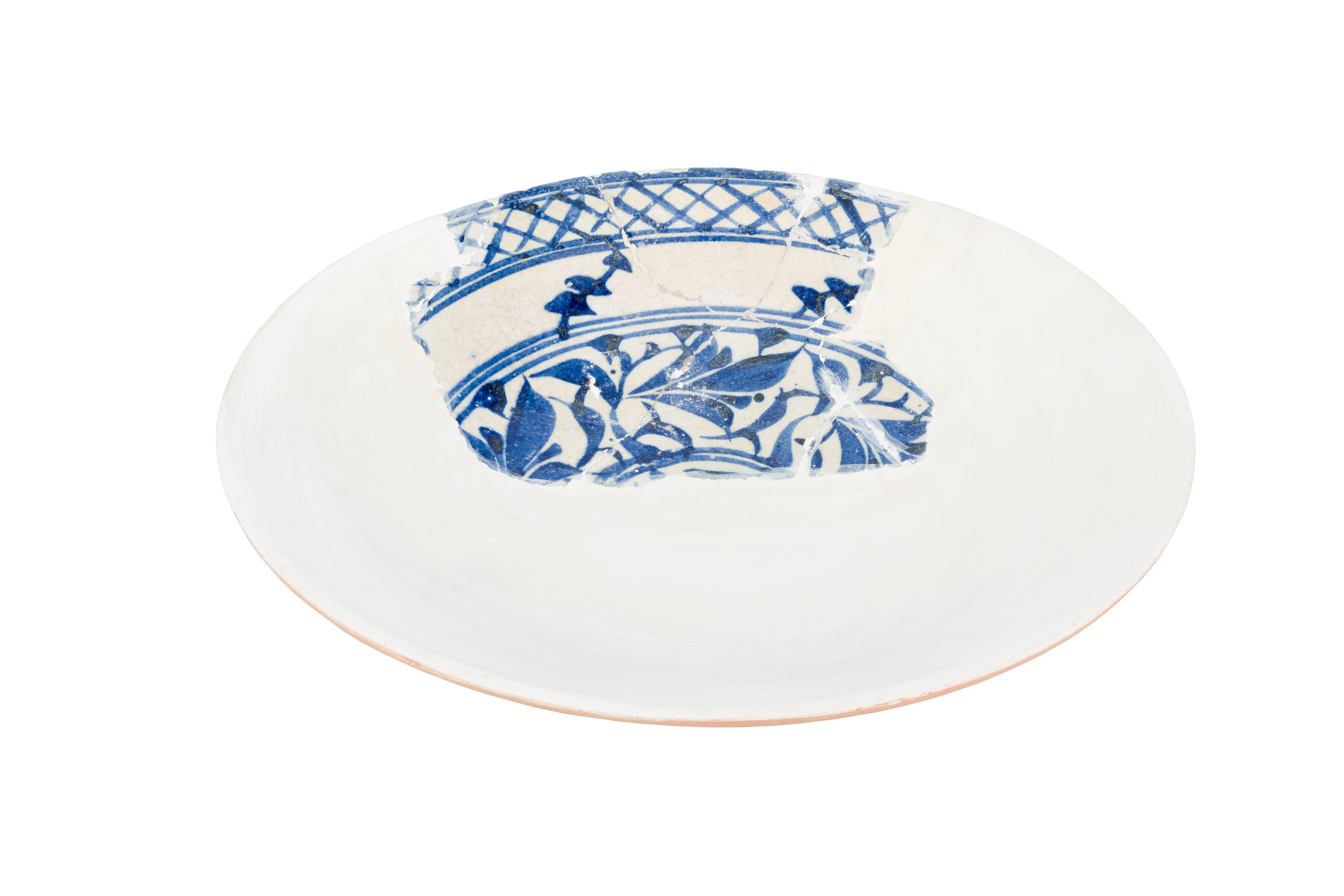
Dish
16th century. Tashkent. Ceramic; colorless glaze. 8 × 35.5 cm. WOSCU collection
Description
This fragment of a sixteenth-century ceramic dish from Tashkent reflects the continuity of artistic traditions rooted in the Timurid period and preserved in the craftsmanship of later generations.
Even the surviving portion of the decoration allows us to reconstruct the original visual concept. Along the inner border runs a vegetal scroll executed in a fluid painterly manner characteristic of Central Asian ceramics. Above it appears a band of lattice-like geometric ornament, creating a deliberate contrast between organic forms and structured linear patterns.
Such a combination of vegetal and geometric decoration is typical of Islamic ornamental language, where natural growth and mathematical order were understood as complementary expressions of visual harmony.
The light surface was achieved through the use of engobe and transparent glaze, enhancing the brilliance of the cobalt pigment while also protecting the ceramic body.
Objects of this kind formed part of the material environment of urban life and testify to the refined aesthetic standards present even in everyday objects produced in sixteenth-century Tashkent.