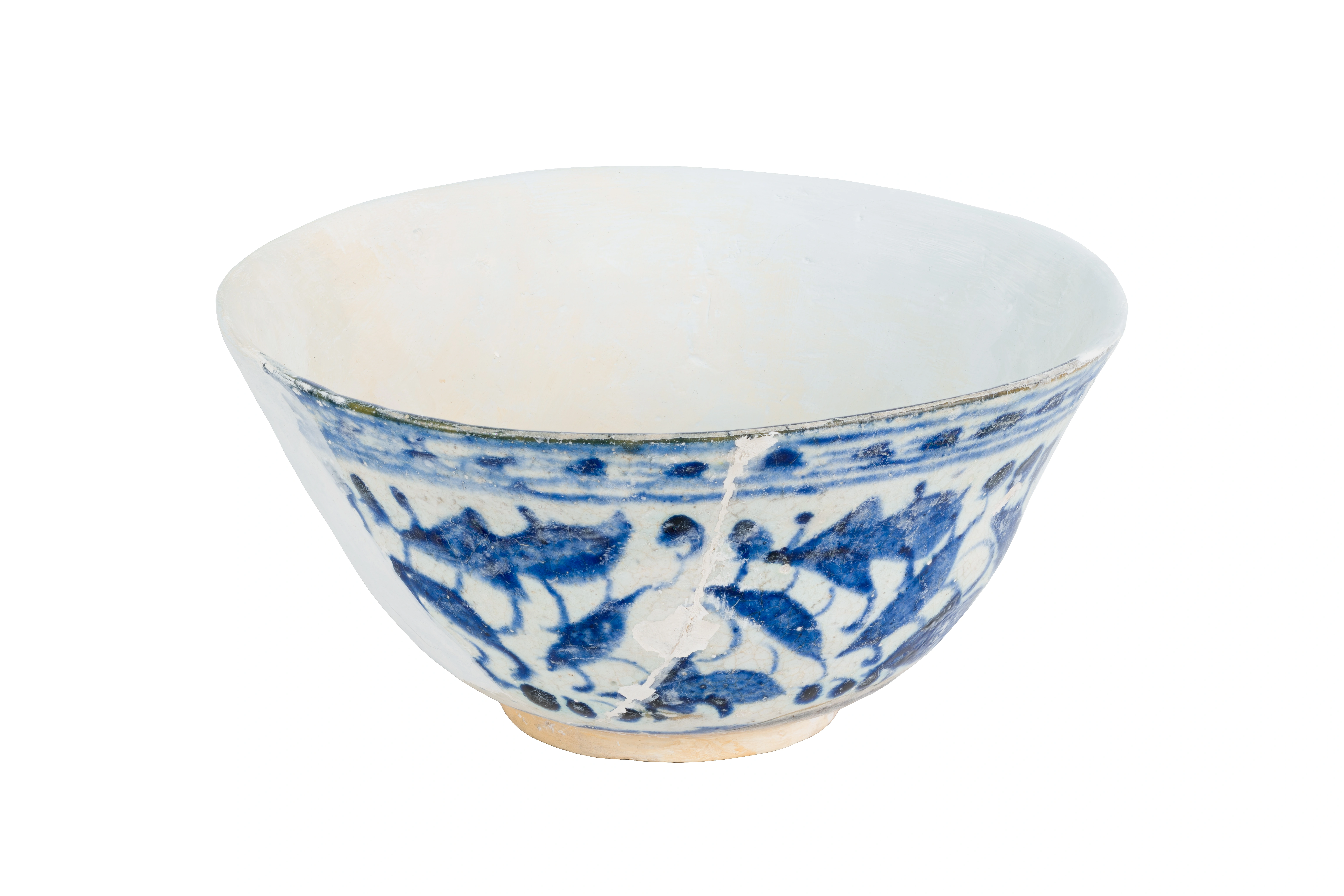
Bowl
15th century CE. Tashkent. Ceramic; glaze, engobe, natural pigments. 9.5 × 19.5 cm. WOSCU collection
Description
The composition of this bowl is organized around a small, almost intimate motif at the center, a stylized flower enclosed within a circular frame. Around it, a wide white field creates a sense of visual pause and spatial openness.
The decoration is executed in cobalt over a white slip and covered with a transparent glaze. This technique produces the characteristic blue-and-white contrast widely seen in Central Asian ceramics of the 15th century, reflecting artistic exchange along major trade routes.
The exterior surface is more densely ornamented: it features a vegetal design with repeating leaves and scrolling stems. Unlike the central medallion, this pattern unfolds continuously along the wall of the vessel, emphasizing its curvature and volume.
On the interior, a fine network of glaze cracks (craquelure) is visible, resulting from natural aging. Lines of repair can also be observed: the object survives in a restored condition. The reconstruction preserves the form while documenting its material history.
The shape with a gently flaring rim and relatively thin walls indicates advanced forming and firing techniques. However, the body remains ceramic; there is no firm basis to identify it as a high-quartz fritware (“kashin”), although the pursuit of lighter and more refined forms is typical of the period.
Such bowls were used in both everyday and ceremonial contexts for serving food, liquids, or fruit. Their decorative program balances restraint on the interior with expressive ornamentation on the exterior.
This object reflects a stable artistic system in which local ceramic traditions are combined with adopted decorative strategies, forming a distinctive regional style of the 15th century.