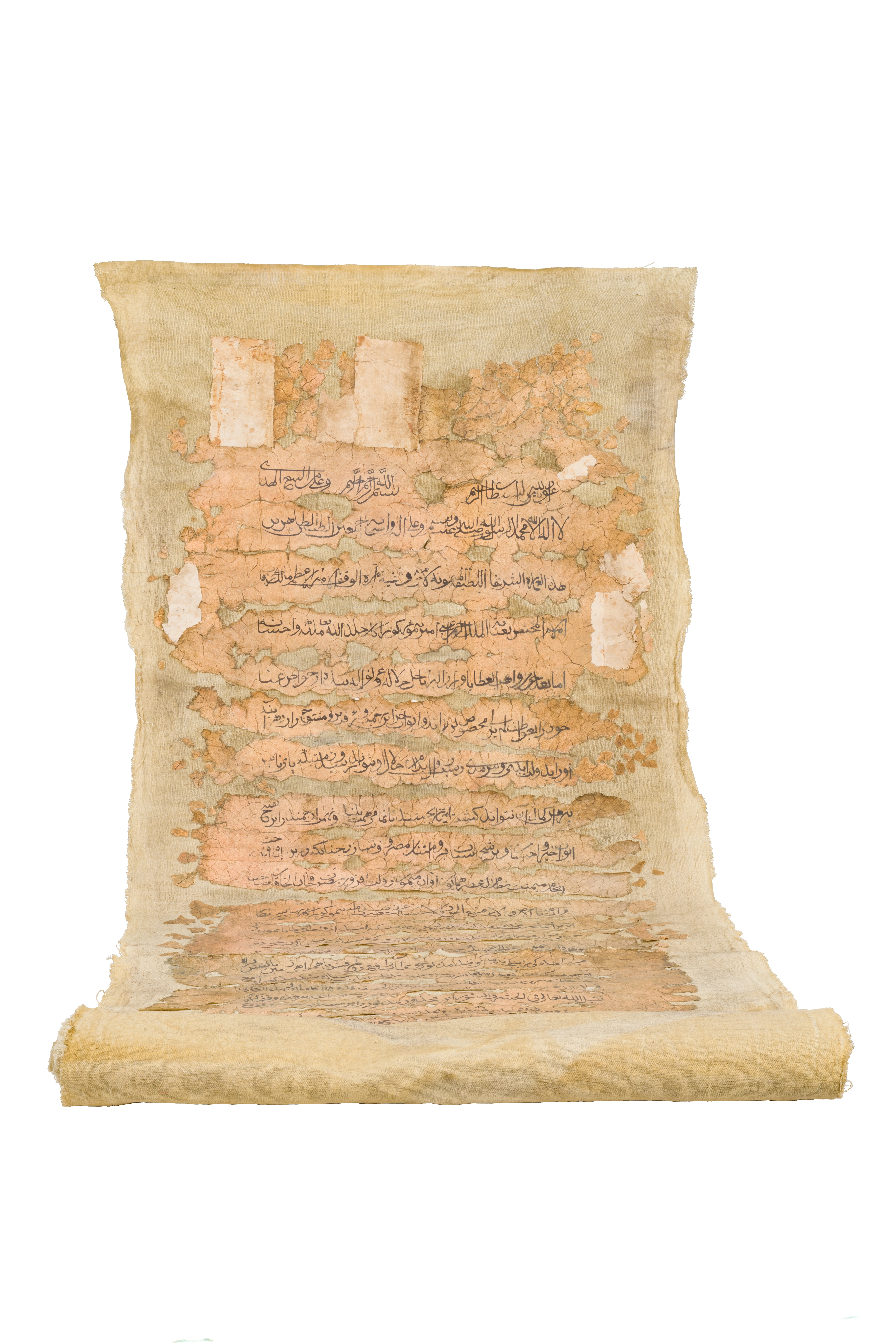
Waqf Document of Amir Timur
14th–15th centuries CE. Central Asia. Persian. Thuluth script. Paper. 91.5 × 45.5 cm. Manuscript of the Institute of Oriental Studies, Academy of Sciences of Uzbekistan
Audio guide
Audio available in: UZ
Description
This rare legal document from the time of Amir Timur represents an important aspect of his rule beyond military conquest – his role as a patron of institutions and urban development.
In the Islamic world, a waqf was a permanent charitable endowment. Property assigned as waqf could not be sold or inherited, and its revenues were dedicated to supporting mosques, madrasas, and social services. Such documents formed the economic foundation of many of Samarkand’s major architectural and educational institutions.
The manuscript is written in Persian, the principal language of administration, scholarship, and law across much of the Islamic East at that time. The calligraphy is executed in the thuluth script, a highly prestigious style traditionally reserved for important religious and official texts.
Such documents typically recorded agricultural lands, markets, irrigation systems, and other revenue sources allocated to sustain religious complexes and scholarly communities.
This manuscript reveals Timur not only as a conqueror, but also as a strategic administrator who invested in the long-term intellectual and spiritual life of his state.