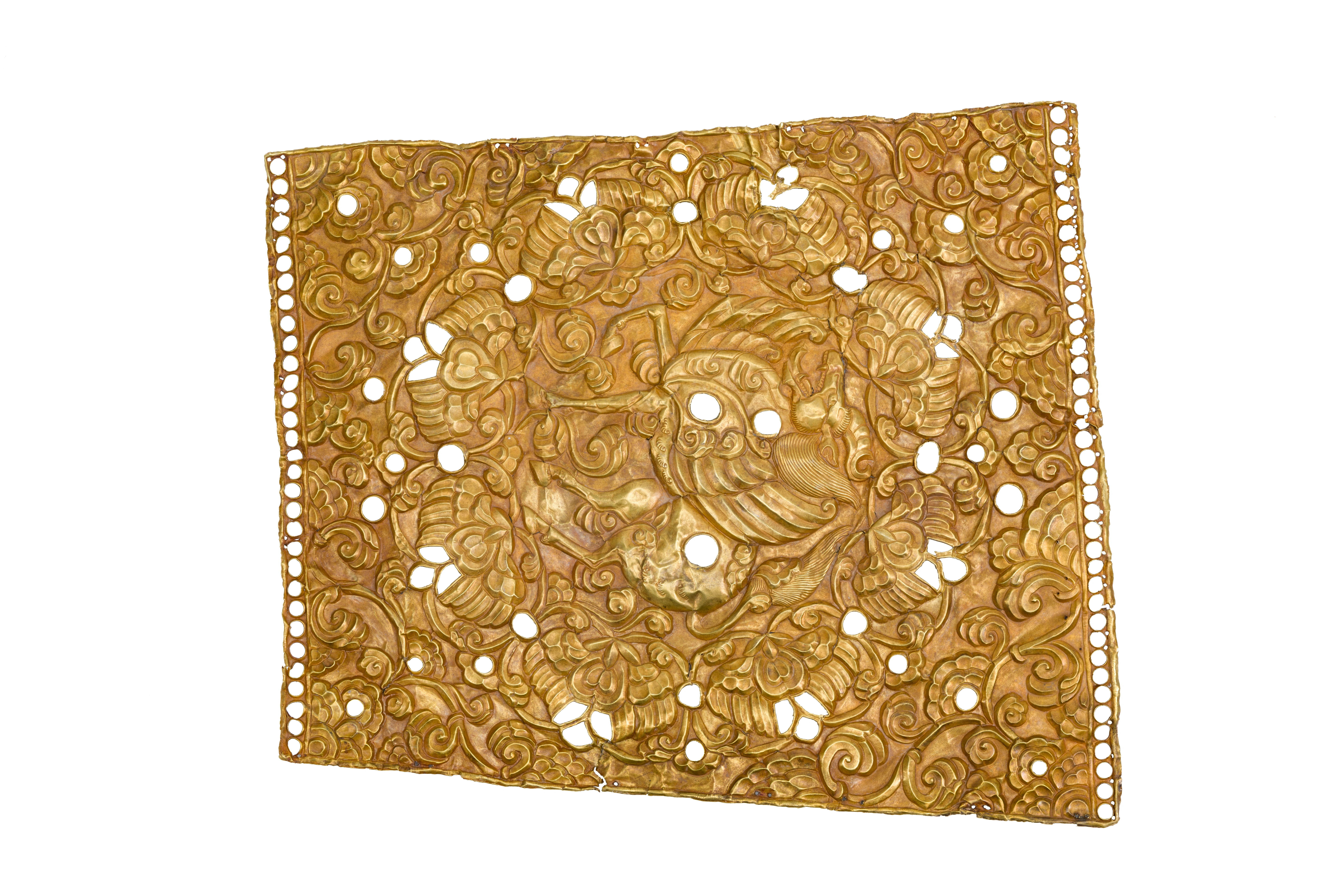
Gold Plate
10th–11th centuries CE. Central Asia. Gold. 38 × 33 cm
Audio guide
Audio available in: UZ
Description
This object combines refined ornamentation with advanced techniques of precious metalworking.
This 10th–11th century gold plaque belongs to the elite artistic production of Central Asia during the Samanid and Karakhanid periods — an era marked by the development of court culture and sophisticated metal craftsmanship.
The decoration is executed in repoussé technique, where the relief is formed by hammering from the reverse side. Working on thin gold sheets required exceptional precision, as the softness of the material made it highly sensitive to pressure. The result is a dense, sculptural vegetal ornament closely related to the islimi tradition.
At the center, a figure of a fantastic creature can be discerned. Such imagery is known in the regional artistic vocabulary and may reflect the continuity of pre-Islamic zoomorphic motifs adapted into the decorative language of the Islamic period.
Numerous perforations across the surface and along the edges indicate that the plaque was not an independent object. It most likely functioned as an applied element — part of a larger composition such as equestrian equipment, architectural decoration, or ceremonial furnishings.
Its size and material suggest a high-status commission, associated with elite display and representation of power.
This artifact exemplifies the cultural synthesis characteristic of Central Asia and demonstrates how precious metal objects carried both symbolic and social significance.