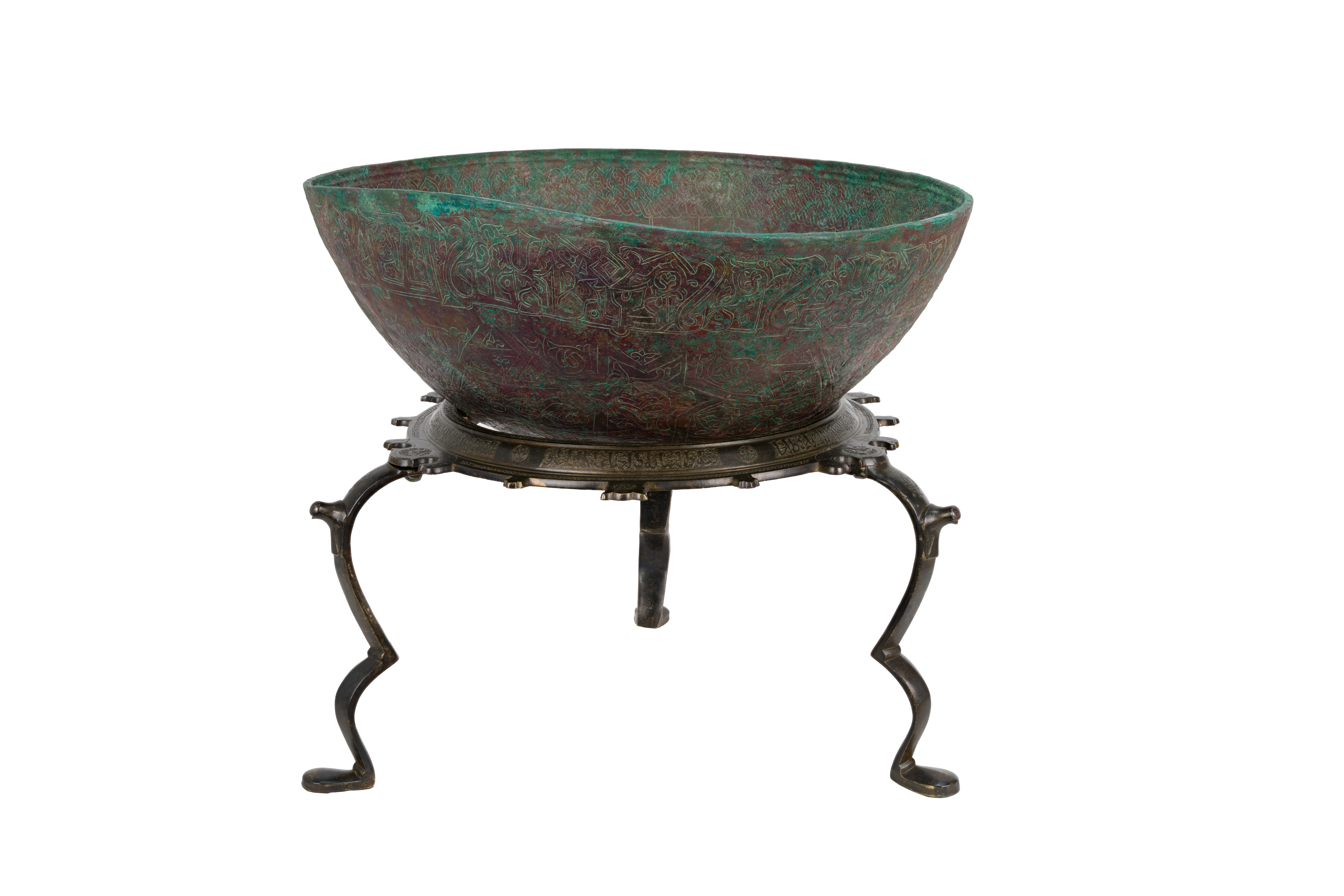
Cauldron on Three-legged Stand
Ghaznavid Period. 11th–12th centuries CE. Brass, bronze. 25 × 58 cm. Stand height: 31 cm
Audio guide
Audio available in: UZ
Description
This object brings together craftsmanship, ritual, and social structure.
This large cauldron from the 11th–12th centuries, mounted on a separate tripod stand, belongs to the ceremonial metalware of the Ghaznavid period. Its scale and construction indicate use in communal dining settings—courtly banquets, religious gatherings, or formal receptions.
The surface of the cauldron is finely engraved, featuring an epigraphic frieze in Arabic script. Such inscriptions typically conveyed blessings—prosperity, health, and longevity—imbuing the object with both decorative and symbolic meaning.
The tripod itself represents a distinct engineering solution. Its curved legs provide stability on uneven or soft surfaces, while the space beneath allowed for a heat source, keeping the contents warm throughout extended gatherings.
The leg forms recall earlier zoomorphic traditions associated with Turkic culture. In the Islamic period, these motifs persist in more stylized and abstract forms.
The object demonstrates the high level of metalwork achieved in Khurasan—a region where key casting and decorative technologies developed and later influenced the broader Islamic world.
This was not merely a vessel, but a center of social life: around it, relationships were formed, alliances strengthened, and a shared cultural space emerged.