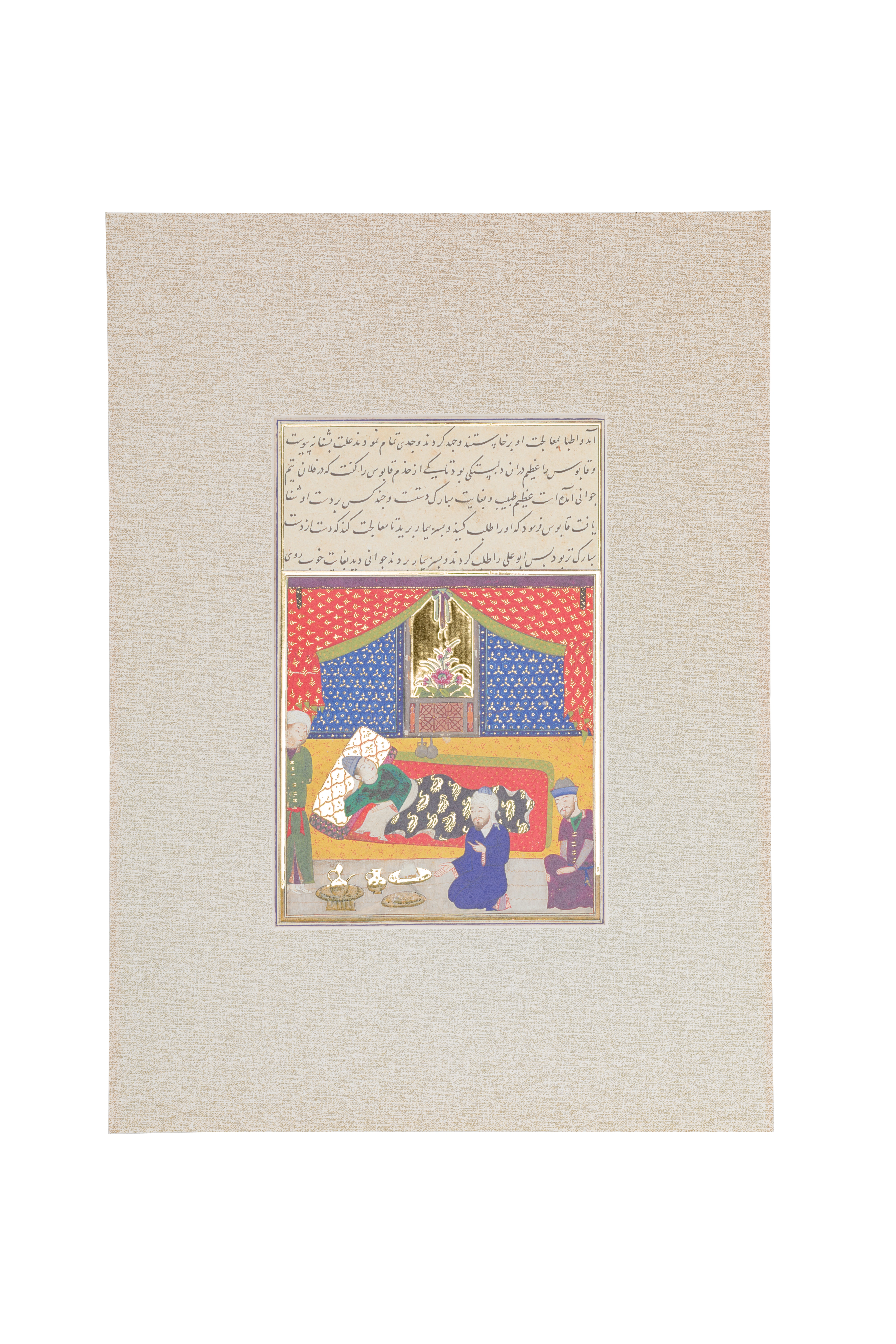
“Abu Ali ibn Sina cures his nephew Qaboos ibn Vashimgir of love sickness”
A miniature for Nizami Aruzi Samarkandi's "Four Articles" ("Chor maqola"). 15th century CE. Shiraz. Pages 43b–44a. 19.8 × 12.7 cm
Audio guide
Description
This miniature presents a medical scene as a thoughtful and reflective exchange. At the center stands Abu Ali ibn Sina, portrayed not only as a physician but as a keen observer of human nature. He is shown treating the nephew of the ruler Qabus ibn Vashmgir for what was described as “lovesickness,” a condition in which physical and emotional states were understood as closely connected.
The episode comes from The Four Discourses by Nizami Aruzi of Samarkand, written in the 12th century. In this work, the author describes four pillars of a cultivated society: poets, scholars, astrologers, and physicians. This 15th-century miniature, created in Shiraz, translates the literary narrative into visual form and emphasizes the importance of medicine within the intellectual framework of the Islamic world.
Notice the calm and intimate atmosphere of the scene. The arrangement of figures guides the viewer through gestures and postures rather than dramatic action. The physician observes, reflects, and questions–suggesting that diagnosis emerges from careful reasoning rather than haste. This reflects a view of medicine as a discipline grounded in observation and analysis.
The miniature illustrates how, during the First Renaissance, medical knowledge was part of a broader cultural system. Science, literature, and art converge here, reminding us that care for both body and soul was considered essential to social and intellectual life across Central Asia and the wider Islamic world.