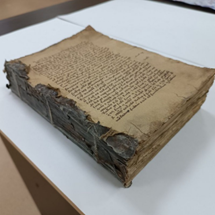
“De numero indorum” (On Indian arithmetic)
Muhammad ibn Musa al-Khwarizmi. Copied in the 14th century CE. Latin. 30 × 22 cm. Süleymaniye Library, Ayasofya Collection (No. 2843), Turkey. Replica
Audio guide
Audio available in: RU
Description
This manuscript is associated with the scholarly legacy of Muhammad ibn Musa al-Khwarizmi, a 9th-century scholar from Khwarezm.
The text represents a key stage in the transmission of knowledge: the spread of the Indian positional numeral system into the Islamic world and subsequently into Europe. The original Arabic version has not survived, but its content is known through Latin translations produced in the 12th century.
The significance of this work lies in its explanation of how numbers can be represented using ten symbols, including zero, and how arithmetic operations can be performed systematically. Unlike the Roman numeral system, this method made calculations far more efficient and consistent.
Particularly important is the structure of the text: it provides not only explanations but also precise procedures — step-by-step methods of calculation. Through the Latinized form of the author’s name, “Algorismi,” the term “algorithm” entered the European intellectual tradition.
This 14th-century copy demonstrates the long-lasting impact of this knowledge. For several centuries, such texts formed the foundation of mathematical education in Europe.
The object illustrates how the intellectual tradition of Central Asia served as a conduit for transmitting fundamental computational principles that underpin modern science and digital culture.