Video available in: UZ
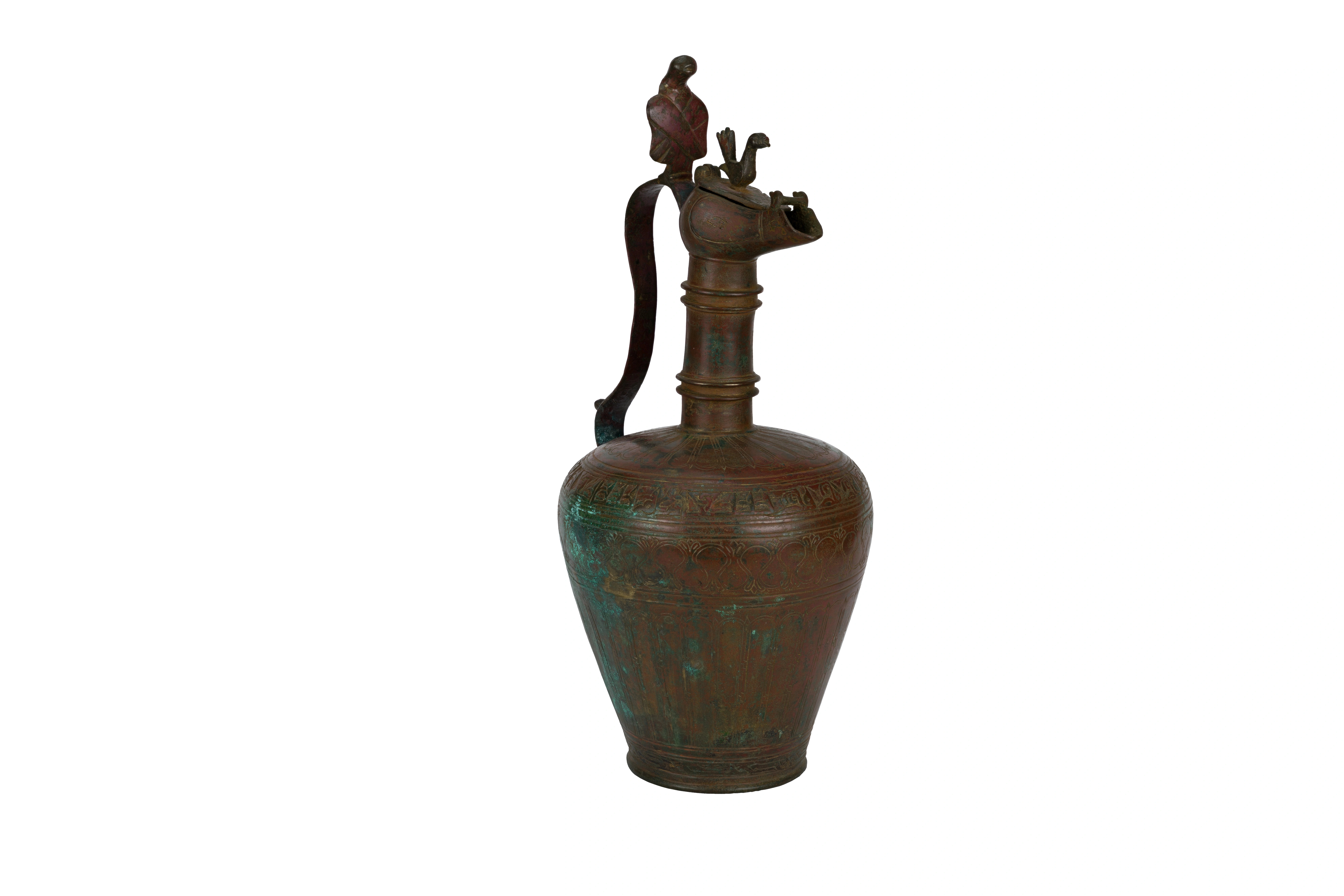
Oftoba (Water Ewer)
10th-13th centuries CE. Mawarannahr. Bronze. 33 × 14.7 cm
Audio guide
Description
This object is an oftoba, a bronze water vessel produced in Mawarannahr between the tenth and thirteenth centuries. Such vessels were widely used throughout the medieval Islamic world for pouring water during hand-washing rituals before meals or prayer.
The form is both elegant and functional. A rounded body rises into a tall neck, while a curved handle allows the vessel to be comfortably held while pouring water.
The most distinctive feature is the spout, shaped as the head of a bird–possibly a falcon or eagle. Zoomorphic details like this were popular in metalwork of the period. Birds often symbolized nobility, strength, and protection, and such images were sometimes believed to bring good fortune to the owner.
The surface of the vessel is decorated with finely engraved ornamental bands. Metalworkers of the Khorasan region–covering parts of present-day Uzbekistan, Iran, Turkmenistan, and Afghanistan–were renowned for their advanced techniques, including intricate engraving and inlay with copper or silver.
The ringed structure of the neck resembles architectural forms such as columns or minarets, reflecting a design vocabulary often inspired by architecture.
Objects like this oftoba combined practical use with refined artistic craftsmanship and were frequently found in elite households or used during ceremonial gatherings.