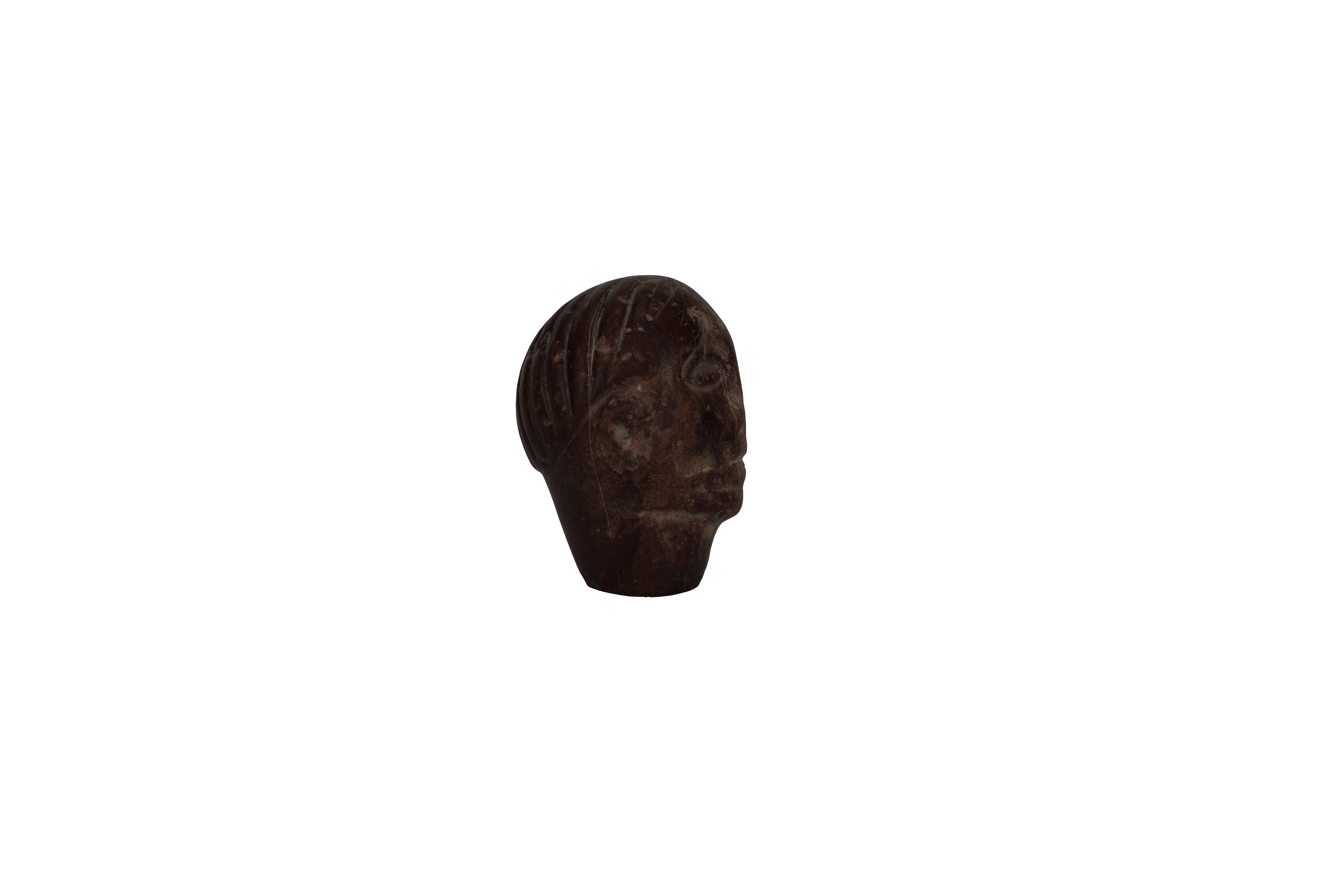
Male Head
10th–7th centuries BCE. Mirshodi, Surkhandarya Region. Stone. 7.5 × 5.5 × 5.3 cm
Audio guide
Description
This small stone head was discovered at the ancient settlement of Mirshodi in the Surkhandarya Region. It dates back approximately four thousand years to the Bronze Age, when the first complex societies were forming in southern Uzbekistan.
Despite its modest size, the sculpture is remarkably expressive. The eyes, nose, and mouth are clearly defined. The face is rendered in a generalized manner, yet conveys a sense of inner presence and character. Such stylistic restraint is characteristic of the artistic traditions associated with the Bactria–Margiana Archaeological Complex.
This head may once have been part of a larger statue or a ritual object. The choice of stone emphasizes durability and significance. It may represent an ancestor, a leader, or a sacred figure.
Finds such as this demonstrate that sculptural art developed in Central Asia long before classical influences reached the region. As early as the second millennium BCE, stable artistic conventions had already been established here.
This sculpture is a rare testimony from deep antiquity, reminding us of the early civilizations of Central Asia.